



TL;DR
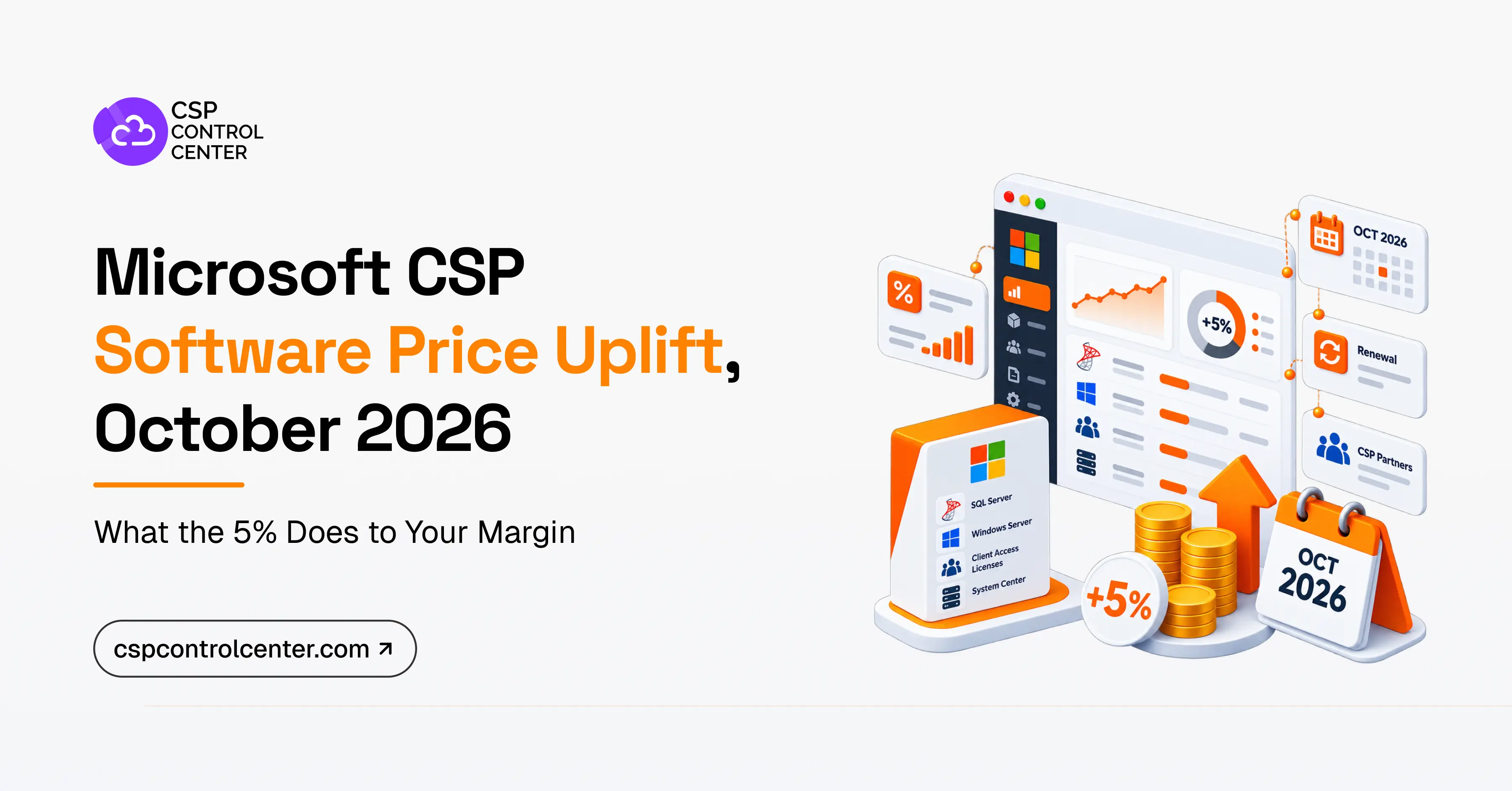
From October 1, 2026, Microsoft applies a 5% cost-of-capital uplift to annual-term Microsoft Cloud Solution Provider (CSP) software subscriptions that are billed monthly, naming SQL Server, Windows Server, Client Access Licenses (CALs) and System Center. Annual billing and month-to-month billing are unaffected. The uplift applies at each subscription’s renewal on or after that date, so it reaches your customer base in stages rather than on a single invoice run.
That is the factual summary of the CSP software price increase, and it is where most coverage of this announcement stops. The commercial point is narrower and more uncomfortable. Microsoft has just made billing frequency a priced attribute of CSP software.
Until now, the price of a software subscription was set by product, term and volume. From October, how often the customer pays carries a price of its own. Partners who have offered monthly billing as a customer-friendly default are about to find that it has a cost, and unless somebody intervenes, that cost is pointed squarely at their own margin.
Key takeaways
- The 5% uplift applies only to annual-term CSP software subscriptions billed monthly, and it lands at renewal rather than on one date.
- Microsoft’s four named products are examples, not a closed list. Audit your catalog on the billing shape rather than on those product names.
- On a 15% resale margin, a 5% cost increase removes roughly 28% of your gross profit. On a 10% margin it removes 45%.
- Holding margin percentage requires the full 5% on the sell price. Holding gross profit in currency requires only about 4.25% to 4.5%.
- Segmentation comes before pricing. You cannot price a change you cannot isolate in your own subscription base.
What exactly changes for CSP software on October 1, 2026?
Microsoft published the change in a Partner Center announcement on August 12, 2026, titled CSP software pricing update effective October 1, 2026. The uplift is a financing charge rather than a product change. Microsoft is pricing the working capital cost of collecting an annual commitment in twelve monthly instalments instead of one, and nothing about the licence, the entitlement or the support alters as a result.
The trigger is a combination of two attributes rather than a product list, which is what makes the scope easy to get wrong:
| Attribute | Treatment from October 1, 2026 |
|---|---|
| Annual term, billed monthly | 5% cost-of-capital uplift, applied at renewal |
| Annual term, billed annually | No change |
| Month-to-month term | No change |
| Microsoft’s named examples | SQL Server, Windows Server, Client Access Licenses, System Center |
| Status of that list | Illustrative. Microsoft has published no closed product list |
| Existing subscriptions | Applied at renewal on or after October 1, 2026, never mid-term |
| Partner Center configuration | No system change required of the partner |
| Relation to the NCE term premium | Separate. NCE prices a shorter commitment, this prices a payment cadence |
The last two rows are where partners get caught. Because Microsoft requires no Partner Center change, the announcement is easy to file as informational and move on. But the absence of a system change on Microsoft’s side is precisely what pushes the entire consequence downstream, into your price lists, your quotes, your renewal workflow and your invoices, where nobody has been assigned to catch it.
Why is a billing-frequency uplift harder to manage than a list-price increase?
A list-price increase has one effective date, applies to a defined set of products, and gets communicated once. This change does none of those three things, and each difference produces a distinct way for the increase to go unpriced:
- There is no single date to plan around. It lands at each subscription’s individual renewal, so what should be one announcement behaves like twelve months of smaller surprises, each too small on its own to trigger a review.
- Quotes go stale silently. A quote issued in September for an October renewal is understated by 5%, and nothing in a typical quoting workflow flags it. The error surfaces at invoice, in front of the customer.
- The margin is absorbed by default. Unless somebody actively decides to pass the uplift through, it comes out of gross profit automatically, one renewal at a time, with no approval step and no alert.
- It is invisible in aggregate. Five percent on a subset of subscriptions spread across a rolling year sits inside normal monthly variance. Aggregate reporting will not show it. A quarter that closes softer than forecast will.
There is useful precedent here. Microsoft announced in November 2024 that from April 1, 2025 it would apply a 5% premium to annual-term seat-based cloud subscriptions billed monthly. That premium covered Microsoft 365, Office 365, Enterprise Mobility and Security, Windows 365, Dynamics 365 and Power Platform, across the CSP, MCA-E and Buy Online channels.
October 2026 extends the same mechanism to on-premises software. Read together, the two changes describe a consistent direction of travel. Payment cadence is becoming a priced commercial term across the Microsoft catalog, not a concession partners can keep giving away without pricing it.
How much margin does a 5% cost uplift actually remove?
This is the question that determines what you should do, and the one most commentary on the change leaves unanswered. A 5% increase in cost is not a 5% problem. It is a 5% increase applied to the largest number in the transaction and absorbed by the smallest one.
Software resale margins in CSP are thin. When the uplift lands on cost while the sell price stays static, the whole increase is subtracted from gross profit, and the share of profit it removes depends entirely on how thin that margin was to begin with. The figures below are arithmetic derived from the stated 5% uplift, not Microsoft estimates.
| Your resale margin | Share of gross profit the uplift removes | Price rise to hold profit in currency | Price rise to hold margin percentage |
|---|---|---|---|
| 5% | 95% | 4.75% | 5.00% |
| 8% | 58% | 4.60% | 5.00% |
| 10% | 45% | 4.50% | 5.00% |
| 12% | 37% | 4.40% | 5.00% |
| 15% | 28% | 4.25% | 5.00% |
| 20% | 20% | 4.00% | 5.00% |
| 25% | 15% | 3.75% | 5.00% |
Put that into a real transaction. A customer pays $10,000 a year for an annual-term software subscription billed monthly. Your cost is $8,500, giving a 15% margin and $1,500 of gross profit. At renewal the cost becomes $8,925, and if the sell price does not move, gross profit falls to $1,075. That is a reduction of 28%.
Restoring it is a smaller adjustment than the headline suggests. Raising the sell price to $10,425, an increase of 4.25%, returns the original $1,500. Raising it to $10,500, the full 5%, returns the original 15% margin percentage and adds $75 on top.
The gap between those two numbers is small, but it is a decision rather than a rounding error. If your commercial model runs on gross profit contribution per account, 4.25% is the right answer, and a flat 5% is a quiet price increase you did not intend to take. If your model runs on margin percentage, 5% is right.
Choose one rule deliberately and apply it across the book, so your renewal conversations stay consistent and your account managers are not improvising a different answer per customer.
One more thing the arithmetic tells you: rank affected customers by absolute margin exposure, not by subscription count. In most CSP books a small number of accounts carry the large majority of affected annual value, and those are the accounts where both the pricing decision and the customer conversation change the outcome.
Can you list the affected subscriptions today?
Before pricing anything, answer a more basic question. Can you produce a filtered list of every annual-term software subscription billed monthly, with its renewal date, its cost and its current margin, without exporting Partner Center data and building a pivot table? For a large number of partners the honest answer is no, and that is the real reason this change is harder than it looks. The pricing decision is straightforward once the list exists. Producing the list is the work.
Your working list needs one row per affected subscription, carrying the customer and tenant, the product, the commitment term, the billing frequency, the renewal date, the current Microsoft cost, the current sell price, and the resulting margin in both currency and percentage. Two of those columns do more work than the rest:
- Billing frequency decides scope. It is the actual trigger for the uplift, and it is the column many partner systems either do not store or do not expose as a filter. This is where the segmentation step defeats otherwise well-run operations.
- Contractual price protection decides eligibility. Where a customer contract fixes pricing for a defined period, the uplift is yours to absorb until that period ends, whatever you decide commercially. Flag those accounts first so they never enter the pass-through workflow and generate an increase you are not entitled to charge.
Should you absorb the uplift or pass it through?
Both answers are defensible. Defaulting into absorption because nobody made the decision is not. The right move depends on the account rather than on a single blanket policy, and the reasoning should be recorded so the next renewal does not reopen the same debate from scratch.
| Account situation | Recommended move | What to watch |
|---|---|---|
| Thin margin, high affected value | Pass through at your chosen rule | Sequence the conversation well before the renewal invoice |
| Healthy margin, strategic or expanding account | Absorb for one cycle, with an end date | Absorption without a review date becomes permanent by inertia |
| Contractual price protection in force | Absorb until the clause expires | Diarise the expiry and reprice at the first permitted renewal |
| Customer is price-sensitive but flexible on cadence | Offer annual billing instead | Model the working capital effect on both sides first |
| Small affected value, admin cost exceeds the margin | Absorb and note it | Confirm it is small by aggregating across the whole account |
| Renewal already quoted at the old price | Honour the quote, reprice next renewal | Fix the quoting workflow so it does not recur in November |
The fourth row deserves more attention than it usually gets, because it is the most customer-friendly answer available and almost nobody is discussing it. The uplift exists to price the cost of monthly collection, which means moving a customer to annual billing on the same annual term removes it entirely. For customers who can fund an annual payment, this costs them nothing and eliminates the increase, and it is a considerably better conversation than a price rise. It also moves your own cash forward. Model the working capital effect on both sides before you lead with it, and be straightforward that the customer is trading payment flexibility for price.
How should you tell a customer their price is going up?
Microsoft’s guidance is to communicate the update in advance to any customer with a renewal on or after October 1, 2026. Sequencing matters more than wording here. A customer told before the renewal treats this as a Microsoft pricing change. A customer who finds it on an invoice treats it as your billing error, and at that point you are defending your own accuracy instead of explaining Microsoft’s pricing.
Work each account in the same order. Confirm the affected subscriptions, the renewal date and the new price before contacting anyone. Then reach out at least one full billing cycle ahead of the renewal, rather than in the week it processes.
State plainly what changed, who changed it and when it takes effect. Name the October 1, 2026 date and the annual-term-billed-monthly condition, so the customer can verify it independently against Microsoft’s own announcement. Show the specific subscriptions affected, which demonstrates this is not a blanket price increase across their estate. Offer the annual-billing alternative where it is realistic for them, and be clear about what they give up.
Then close the loop in writing before the renewal processes, and make sure the agreed price is what the billing system actually holds. That last step is where the process usually breaks. An agreed price that never reaches the billing configuration produces exactly the invoice dispute the whole conversation was meant to prevent, and it costs more credibility than the original increase ever would have.
What does this mean for indirect resellers and distributors?
Almost all commentary on this change is written for the direct-bill partner. The indirect channel has a harder version of the same problem, and Microsoft’s own announcement on annual local currency pricing confirms that indirect providers and indirect resellers sit squarely in the impacted audience for pricing changes of this kind. Three things behave differently in two-tier:
- The provider absorbs it first. Indirect providers hold the Microsoft relationship, so whether the uplift reaches the reseller at all depends on the provider’s own pricing rules, and those rules have to be updated on purpose.
- Resellers see it late, and out of sequence. A reseller may not learn of the change until the provider passes it on, which can happen after October 1 and on a cadence unrelated to the underlying Microsoft renewal, leaving them explaining a timing they cannot justify.
- Margin stacking can double the increase. If the provider prices off cost and the reseller also prices off cost, 5% can be applied twice, producing a customer-facing rise materially larger than the one Microsoft made.
If you operate a reseller channel, decide your pass-through rule once, publish it to resellers before October 1, and apply it in the catalog rather than in individual quotes. Resellers who learn about a cost change from their own customer’s invoice do not stay long.
Why price-list accuracy is now an operational discipline
A 5% uplift is only priced correctly if the price list your quoting and billing systems read is current, and that is a weaker assumption than most partners realise. Microsoft’s monthly CSP price list is not always final when it is first published.
Microsoft republished the August 2026 list mid-month, on August 13, to add Windows Server 2016 Extended Security Updates offers delayed from the regular publication. It did the same again on September 8, republishing the September 2026 list for Windows 10 Enterprise LTSC 2021 Extended Security Updates offers held back for the same reason. Two mid-month republishes in consecutive months is a pattern, not an anomaly.
If your price list lives in a spreadsheet, or was imported into a professional services automation tool at the start of the month, a mid-month republish never reaches it. The system carries on quoting confidently from a file that is no longer correct, and nobody finds out until a customer queries an invoice. Three controls close that gap, and they are worth building now because October is not the last time you will need them:
- Pull price lists on a schedule rather than on request, so a republished list reaches your pricing engine without anyone remembering to import it.
- Version and date every price list your systems use, so you can answer which list a given quote was priced from.
- Reconcile the first post-renewal invoice against the expected new cost, subscription by subscription, rather than checking the total.
What comes after October 2026?
Treat this as the first run of a process rather than a one-off task, because Microsoft has already published what comes next. In a Partner Center announcement dated July 8, 2026, Microsoft confirmed that Commercial Cloud moves to annual local currency pricing updates every January, with the first update effective January 1, 2027 and notifications issued each November. Detailed guidance on the January 2027 update is due in November 2026.
That makes a November notification and a January 1 effective date a recurring fixture in the CSP calendar, alongside whatever product-specific changes Microsoft communicates separately. Partners who build the segmentation, the pricing decision and the customer communication workflow once for October will run the January cycle in a fraction of the time. Partners who handle October by hand will do the same manual work again, with less notice, in the middle of a quarter.
Related reading
- The Microsoft CSP Profitability Playbook
- Microsoft CSP 2026 Program Changes: What New Revenue Minimums Mean for Partners
- Azure Consumption Volatility: Why CSP Margins Are Becoming Harder to Predict
How CSP Control Center helps you price this change instead of absorbing it
Most of the difficulty in this change is not analytical. It is that the data needed to make the decision sits in one system, the pricing decision is executed in another, and the invoice is produced in a third.
CSP Control Center brings Microsoft CSP price-list and catalog management, custom pricing and margin control, subscription filtering, and automated renewal and invoicing into one platform. You can filter the subscription base by term and billing frequency, which isolates exactly which subscriptions the uplift touches.
From there you can see margin at subscription and customer level rather than at quarter close. You can apply customer-specific pricing rules, so an agreed price reaches the invoice without a manual step. And you can keep price lists synchronised, so a mid-month republish does not leave your quotes behind.
The result is that a Microsoft cost change becomes a pricing decision your team makes on purpose, on a timetable, rather than a margin outcome you discover at quarter end.
Book a demo to see how CSP Control Center handles price-list changes, margin visibility and renewal pricing for Microsoft CSP partners.
Frequently asked questions
Is the October 2026 change a blanket 5% increase across Microsoft CSP?
No. It applies only to annual-term CSP software subscriptions that Microsoft bills monthly. Annual-term subscriptions billed annually and month-to-month subscriptions are unaffected, and seat-based cloud subscriptions fall outside the scope of this particular announcement.
Which products are affected by the CSP software price uplift?
Microsoft names SQL Server, Windows Server, Client Access Licenses and System Center as examples. It has not published a closed list, so screen your catalog on the billing shape, meaning annual term billed monthly, rather than on those four product names alone.
Does the uplift apply to subscriptions that are already active?
Not mid-term. Existing subscriptions keep their current pricing until renewal, and the uplift applies at renewal on or after October 1, 2026. That is why the impact arrives staggered across roughly twelve months rather than on a single invoice date.
Can a customer avoid the 5% uplift?
Yes, by moving to annual billing on the same annual term, since the uplift prices the cost of monthly collection rather than the licence itself. The customer trades payment flexibility for price, so treat it as a commercial option to offer rather than a default to impose.
How much should a partner raise the sell price to offset the uplift?
To hold gross profit in currency, raise the sell price by 5% of your current cost, which works out at roughly 3.75% to 4.75% of the sell price depending on your margin. To hold margin percentage, raise the sell price by the full 5%. Pick one rule and apply it consistently across the book.