



TL;DR
Azure consumption has become far more unpredictable due to AI workloads, elastic scaling, evolving Microsoft pricing, and customer-led cost optimization. This volatility makes it harder for Microsoft CSPs to forecast revenue, protect margins, and reconcile billing accurately. Spreadsheet-based operations and delayed visibility often lead to billing errors, margin leakage, and customer disputes. To stay profitable, CSPs need real-time consumption visibility, automated billing and reconciliation, and integrated FinOps practices. Platforms like CSP Control Center help partners detect cost anomalies early, automate financial workflows, and protect margins in an increasingly consumption-driven business.
Key Takeaways
- Azure consumption is no longer predictable. AI workloads, dynamic scaling, and hybrid cloud cause frequent usage spikes that hit billing and profitability.
- Margin leakage stems from operational gaps. Manual reconciliation, delayed billing data, and limited visibility make it hard to act before profits are affected.
- Fixed-price contracts carry higher risk. Unexpected usage increases quickly erode margins when costs exceed estimates.
- Microsoft’s evolving pricing adds complexity. Changes to NCE, rebates, and partner incentives require continuous operational adaptation.
- Operational maturity is a competitive advantage. CSPs with automated billing, real-time reporting, and integrated FinOps forecast better and protect margins.
- Proactive visibility beats reactive reconciliation. Catching anomalies during the billing cycle reduces financial exposure.
What Is Azure Consumption Volatility and Why It’s Getting Worse?
Azure consumption volatility refers to unpredictable fluctuations in customer cloud usage and associated infrastructure costs over time. Unlike traditional software licensing models, where revenue is relatively stable and predictable, Azure consumption can change quickly based on customer behavior. A sudden increase in AI workloads, infrastructure scaling, seasonal demand, application usage, or even cost optimization efforts can significantly impact monthly cloud spend. For Microsoft CSPs, this makes forecasting revenue and margins far more complex than it was in traditional recurring licensing models.
A few numbers highlight the scale of the challenge. Azure is projected to reach nearly $87 billion in revenue in 2025, with growth approaching 38% year over year, according to market analysis from SiliconANGLE. Meanwhile, global cloud infrastructure spending reached $95.3 billion in Q2 2025 alone, growing 22% year over year as AI workloads and cloud-native enterprise adoption continue to accelerate.
At this pace, the volume of consumption data, billing events, usage fluctuations, and reconciliation cycles that CSPs need to manage is growing far faster than most traditional operational and financial systems were originally designed to handle.
The volatility is becoming more pronounced across the Microsoft CSP ecosystem for several reasons.
- Pay-as-you-go pricing means that almost every infrastructure decision a customer makes, whether it is spinning up a virtual machine, running a large analytics query, increasing storage, or deploying a new service, creates a direct billing event that the CSP must accurately track and reconcile.
- Elastic scaling, one of Azure’s biggest advantages, also adds unpredictability. Compute and storage usage can spike within minutes based on application demand, often without any advance visibility for the CSP managing the account.
- AI and GPU-driven workloads are adding another layer of complexity. Unlike traditional enterprise applications that follow relatively stable usage patterns, AI infrastructure tends to be bursty, resource-intensive, and event-driven. A single training workload or inference spike can dramatically change monthly consumption patterns.
- Hybrid and multi-cloud environments are also reshaping how enterprises consume infrastructure. As workloads move dynamically across environments, CSPs are finding it increasingly difficult to accurately forecast monthly Azure consumption and revenue patterns.
- Cost optimization programs such as Reserved Instances and Savings Plans introduce new margin management challenges. While they can improve efficiency when used correctly, they also create financial exposure if customers underutilize committed capacity or rapidly shift workloads after commitments are locked in.
The core issue is that Azure’s biggest strength, dynamic and flexible consumption, is also what makes it operationally difficult for partners to manage at scale. Consumption volatility is no longer just a finance challenge tied to revenue forecasting and margins. It has become a broader operational challenge that affects billing accuracy, reconciliation, forecasting, customer management, and day-to-day financial visibility.
The CSP Margin Problem: How Volatility Hits Your Bottom Line
CSP margins on Azure are thin by design. Partners earn through the spread between Microsoft’s pricing and the customer’s billed amount, plus incentives, rebates, and managed service revenue. That model works when consumption stays stable—but breaks down when usage becomes volatile and hard to forecast. Even small shifts in infrastructure behavior can create real uncertainty around margins and profitability across the billing cycle.
Two challenges drive most of the risk:
Fixed-price exposure: Many CSPs offer fixed monthly estimates or capped Azure pricing, especially to smaller customers who want predictable budgets. When actual usage blows past those estimates—a dev team leaving high-compute workloads running over a long weekend, or an AI pipeline consuming GPU capacity for days—the CSP often absorbs the overage before anyone catches it.
Reconciliation lag: Azure billing data isn’t fully real-time. Usage moves through Microsoft’s systems with delays, so a spike early in the month may not surface until weeks later—after the billing cycle has progressed and invoice disputes have become much harder to resolve.
On top of this, customers increasingly expect pricing flexibility, cost optimization, and ongoing efficiency guidance. CSPs end up juggling fluctuating infrastructure costs, evolving Microsoft incentives, constant optimization pressure, and growing reconciliation complexity all at once.
Margin management is no longer just a finance reporting function. It’s a real-time operational challenge tied to forecasting accuracy, customer relationships, and profitability—shaped by variables CSPs can’t fully control: customer deployment and scaling behavior, AI workload growth, workload shutdowns, and shifting Microsoft pricing.
Key ways Azure consumption volatility impacts CSP margins:
- Fixed-price contracts turning unprofitable during usage spikes
- Delayed visibility into billing and reconciliation data
- Difficulty forecasting monthly cloud revenue
- Margin erosion from unexpected AI and GPU consumption
- Lost value from underutilized Reserved Instances and Savings Plans
- Rising operational overhead for finance and billing teams
- Customer disputes over unexpected cost increases
- Pressure to optimize customer spend without cutting partner margins
Why Azure Margins Have Become Harder to Predict
Azure margins are becoming much harder for CSPs to forecast because the way customers consume cloud infrastructure has changed dramatically over the last few years.
Earlier, most CSP businesses operated in relatively stable environments. Infrastructure usage grew gradually, workloads followed fairly predictable patterns, and monthly billing trends remained consistent enough to forecast with reasonable accuracy. That made revenue planning, margin management, and operational forecasting far more manageable than they are today. That predictability is disappearing for several reasons, including:
AI Workloads Are Creating Consumption Spikes
AI adoption is introducing an entirely new level of infrastructure unpredictability into Azure environments. GPU-intensive workloads, Azure OpenAI consumption, model training activity, inference scaling, and Copilot-driven infrastructure demand are fundamentally changing how cloud usage behaves.
Traditional enterprise workloads typically followed relatively stable and predictable utilization patterns. AI workloads behave very differently. They are often highly variable, resource-intensive, and driven by real-time usage events. For CSPs, this creates a major forecasting challenge because historical consumption trends are becoming far less reliable indicators of future infrastructure demand.
Customers Are Optimizing Cloud Spend More Aggressively
Customers are also under growing pressure to optimize cloud costs. Cloud infrastructure spending is no longer treated as an unlimited growth category. Finance teams, procurement leaders, and CFOs are pushing for tighter infrastructure efficiency, stronger workload governance, and clearer visibility into cloud ROI.
As a result, many organizations are actively:
- Rightsizing infrastructure
- Shutting down underutilized workloads
- Consolidating cloud resources
- Renegotiating long-term commitments
- Expanding FinOps and cost governance practices
For CSPs, this introduces another layer of unpredictability into revenue forecasting. Customers that aggressively optimize their cloud environments can significantly reduce Azure consumption within relatively short timeframes, directly impacting projected revenue and margins.
If a customer reduces Azure consumption by 30% within a single quarter through aggressive FinOps initiatives, the CSP’s revenue from that account declines alongside it. And if the CSP had already made operational, staffing, or infrastructure commitments based on the customer’s earlier consumption levels, the resulting margin pressure becomes even more difficult to absorb.
Microsoft Pricing and Incentive Structures Keep Evolving
CSP margins are not driven solely by customer consumption. They are also heavily influenced by Microsoft’s evolving pricing models, partner incentives, rebates, and commercial structures, all of which have changed significantly in recent years.
One of the biggest structural shifts has been the transition to the New Commerce Experience (NCE), which fundamentally changed how CSPs manage commitments, pricing flexibility, renewals, and customer billing relationships. For a deeper look at how to navigate Microsoft’s evolving commitment structures, the Direct CSP Playbook for 2026 covers the practical implications for pricing and renewals.
Beyond NCE, Microsoft’s partner incentive programs, rebate structures, and Azure pricing models have continued to evolve regularly. Changes to Partner Earned Credit (PEC) mechanics, managed service qualification thresholds, and the removal of legacy Azure offer margins have all materially changed how CSP profitability is calculated.
For CSPs, this means profitability has become significantly harder to model over long time horizons. Even when customer consumption remains relatively stable, changes in Microsoft’s pricing structures, incentives, and qualification requirements can materially affect realized margins.
Billing Timing Mismatches Create Financial Exposure
One of the most underestimated challenges in Azure operations is billing timing misalignment. Azure consumption data is generated in real time, but it moves through Microsoft’s billing and reconciliation systems with delays before becoming fully visible to CSPs. As Microsoft’s Azure plan billing documentation outlines, daily-rated usage is reconciled on a monthly billing cycle, creating a gap during which partners are effectively carrying infrastructure costs without complete visibility into their actual financial exposure.
This delay creates several operational and financial challenges for CSPs. Invoice adjustments may arrive after customer billing cycles have already closed, foreign exchange fluctuations can impact costs between the time usage occurs and payments are collected, and credit or rebill requests often require time-consuming manual intervention from finance teams.
Over time, these timing mismatches create a deeper problem: a disconnect between when revenue is recorded and when actual margins become clear. For CSPs managing dozens or even hundreds of customer environments, these small gaps accumulate into a significant and often overlooked drag on overall profitability.
Key Drivers Behind Azure Margin Volatility
- AI and GPU workloads are creating unpredictable consumption spikes
- FinOps initiatives are reducing stable infrastructure spend
- Microsoft pricing and incentive structures continue to evolve
- Billing and reconciliation delays are impacting margin visibility
- Historical usage patterns are becoming less reliable for forecasting
The Operational Problem Most CSPs Underestimate
The real challenge is not Azure volatility itself. Azure is designed to be dynamic, elastic, and consumption-driven, which is exactly what customers value about the platform. The problem is that many CSP operational and financial systems were originally built for a very different business model. Traditional CSP workflows assumed:
- Relatively predictable monthly billing
- Stable SKU behavior
- Slower pricing changes
- Simpler reconciliation requirements
Azure consumption businesses operate very differently. Consumption-driven cloud operations require:
- Continuous visibility into infrastructure usage
- Dynamic and constantly updated forecasting
- Near real-time billing and reconciliation workflows
- Much tighter coordination across finance, operations, billing, and customer success teams
Many CSPs, however, still rely heavily on spreadsheets, fragmented reporting systems, disconnected operational tools, and manual reconciliation processes. The result is a growing number of operational blind spots, especially as Azure environments become larger, faster-moving, and more complex to manage.
Many CSPs still identify margin erosion only after invoices have already been finalized rather than during the active consumption cycle itself. By the time the issue becomes visible, the financial impact has already occurred.
For CSPs managing multiple customer environments, inefficiencies in cloud usage rarely disappear on their own. They eventually show up either as customer billing disputes or as direct pressure on partner margins.
Where Margin Leakage Actually Happens
CSP margin problems are rarely caused by one major failure. In most cases, they build up gradually across multiple operational gaps, each creating a small but consistent impact on overall profitability.
| Operational Area | Common Problem | Margin Impact |
|---|---|---|
| Azure usage forecasting | Consumption spikes missed | Underestimated costs |
| Billing reconciliation | Delayed adjustments | Revenue leakage |
| Reserved Instance management | Underutilization | Lower profitability |
| Customer invoicing | Manual errors | Disputes & delayed payments |
| Multi-tenant visibility | Incomplete reporting | Hidden margin erosion |
| FX management | Currency fluctuations | Reduced realized margin |
By the time margin impact becomes visible in financial reports or reconciliation workflows, the opportunity to intervene has usually already passed. That is why treating margin management as only a finance function, instead of an operational one, often leads to delayed reactions and recurring profitability issues.
What Operationally Mature CSPs Are Doing Differently
The CSPs managing Azure consumption volatility most effectively are not necessarily the ones with the largest teams or the most sophisticated technology stacks. They are usually the ones that have built operations around the realities of a consumption-based cloud business.
Instead of treating billing, reconciliation, forecasting, and profitability tracking as separate functions, they operate them as connected workflows. That gives them stronger visibility, better automation, and tighter operational control throughout the billing cycle rather than only after financial impact has already occurred.
Real-Time Consumption Visibility
Mature CSPs operate with near real-time visibility into customer-level Azure consumption. Instead of waiting for end-of-month reconciliation reports, they continuously monitor usage trends, cost trajectories, and anomaly signals as consumption happens.
This does not eliminate volatility, but it makes volatility visible early enough to act on it. If a customer’s Azure spend is already trending 40% above the monthly estimate by day ten, that should trigger an operational response immediately rather than turning into a difficult billing conversation after invoices are generated.
Automated Billing and Reconciliation
Manual reconciliation remains one of the biggest operational bottlenecks in CSP billing. Processing Azure usage data, mapping it against customer contracts, calculating margins accurately, and generating invoices becomes slow, error-prone, and heavily delayed when handled through manual workflows.
Operationally mature CSPs are increasingly automating core financial and billing workflows. The highest-impact workflows to automate first typically sit directly inside the billing and reconciliation cycle, including:
- Usage ingestion
- Billing operations
- Invoice generation
- Reconciliation workflows
- Profitability and margin tracking
This reduces operational delays, minimizes manual errors, and gives teams much better visibility into real-time financial performance.
Integrated FinOps + CSP Operations
One of the biggest structural gaps in many CSP businesses is the disconnect between finance and operations teams. Finance tracks margins and billing performance, while operations manages customer environments and service delivery, often using completely different systems and datasets.
The result is that neither team has a fully real-time view of profitability, making it harder to identify margin leakage before the financial impact has already occurred.
More mature CSPs are embedding FinOps principles directly into day-to-day operations to improve:
- Forecasting accuracy
- Cost optimization visibility
- Customer-level profitability tracking
- Infrastructure efficiency management
This creates a far more proactive operating model, where teams can identify and respond to margin risks early instead of reacting only during reconciliation cycles.
Multi-Tenant Operational Control
Managing Azure consumption for a single customer is relatively manageable. Managing 50, 100, or 500 customer environments across different usage patterns, pricing models, and margin structures is an entirely different operational challenge.
At that scale, manual account-level processes stop working. CSPs need a centralized operational layer that provides unified visibility, automation, and control across the entire customer base.
This is where purpose-built platforms like CSP Control Center (C3) become increasingly important. These platforms are designed specifically for modern CSP operations, providing centralized visibility into Azure consumption, automated billing and reconciliation workflows, anomaly detection, and real-time margin tracking across multi-customer environments.
Instead of reacting to margin issues after reconciliation cycles close, CSPs can use operational intelligence to identify consumption spikes, billing risks, and profitability issues as they happen, making volatility far more manageable at scale.
Reactive CSP Operations vs Mature Consumption Operations
| CSP Capability | Reactive CSP Operations | Mature Consumption Operations |
|---|---|---|
| Tracking Method | Spreadsheet-driven, manual exports | Automated workflows and dashboards |
| Reconciliation Cycle | Monthly batch reconciliation | Continuous or near real-time visibility |
| Margin Visibility | Delayed profitability tracking | Real-time margin intelligence per customer |
| Invoice Process | Manual adjustments and corrections | Automated reconciliation and invoicing |
| Forecasting Approach | Static pricing assumptions | Consumption-aware dynamic forecasting |
| Anomaly Response | Discovered post-invoice | Alerted during active consumption cycle |
| Operational Focus | Billing-centric | Operational intelligence-driven |
Related Reading
- What Microsoft CSPs Should Automate First: The Top 7 Workflows
- Microsoft CSP Margin Compression: Causes, Signals, and Fixes
- Inside the Top 10% of Microsoft CSPs: How the Most Profitable Partners Scale
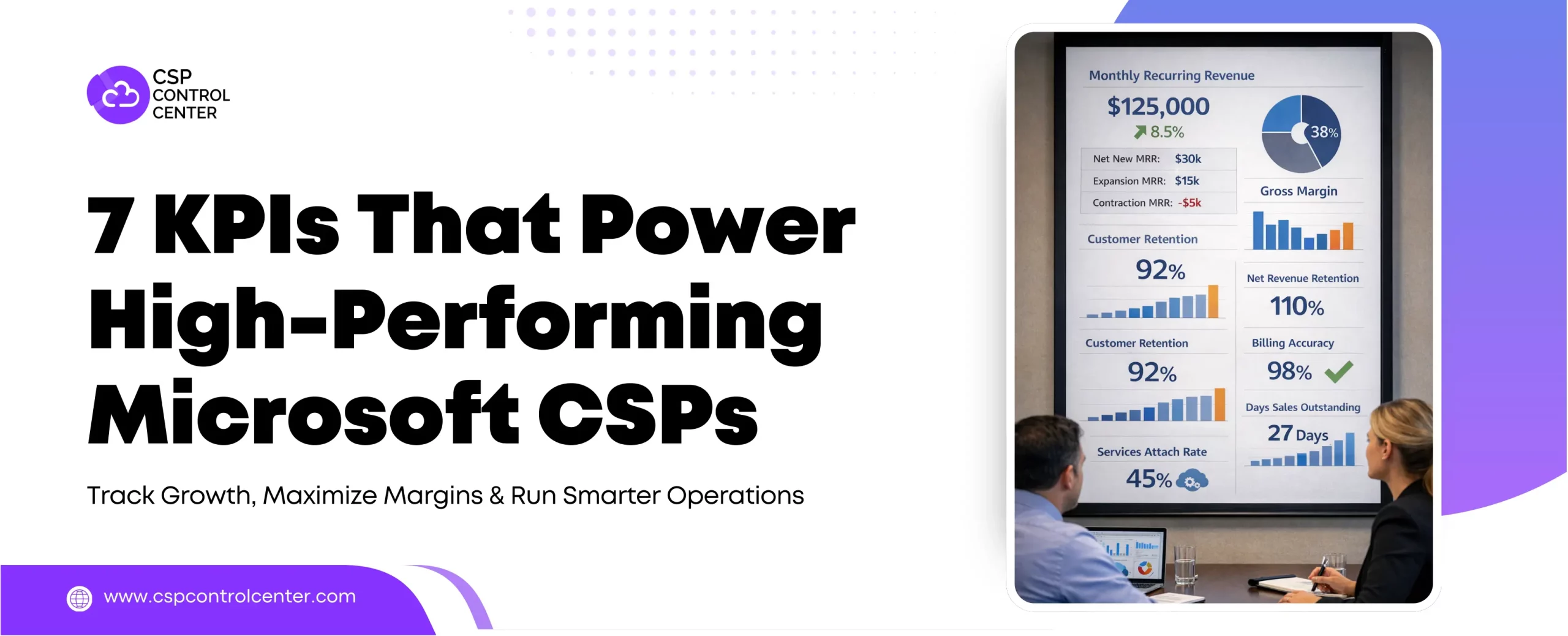
- 7 KPIs That Power High-Performing Microsoft CSPs
Final Takeaway
Azure consumption volatility is not a short-term disruption. AI infrastructure growth, dynamic scaling patterns, evolving Microsoft pricing structures, customer-driven optimization, and increasingly complex cloud environments are fundamentally reshaping how CSP businesses operate.
The CSPs that succeed over the long term will not necessarily be the ones selling the most Azure. They will be the ones with the strongest operational foundations for managing consumption visibility, reconciliation, forecasting, and profitability in real time.
The question is no longer whether CSP operations need to modernize. The real question is how much margin leakage businesses are willing to absorb before they do. Platforms like CSP Control Center are designed specifically for this new operating reality, helping Microsoft CSPs improve visibility, automate reconciliation workflows, strengthen profitability tracking, and manage Azure consumption more proactively at scale.
If your current billing and operational systems still rely heavily on delayed reporting and manual reconciliation, it may be time to rethink the operational layer behind your CSP business. You can book a demo with CSP Control Center to see how the platform works across your CSP environment.
Frequently Asked Questions
Why are Azure CSP margins becoming unpredictable?
Azure CSP margins are becoming harder to predict because cloud consumption behaves far more dynamically than traditional recurring licensing revenue. AI workloads, customer-led cloud optimization, evolving Microsoft incentive structures, and delayed billing visibility are all making revenue forecasting and profitability management significantly more complex for CSPs.
How does Azure consumption volatility affect CSP profitability?
Consumption volatility impacts profitability by making forecasting, reconciliation, and cost visibility much harder to manage. A sudden usage spike can quickly wipe out margins on fixed-price customer agreements, especially when CSPs lack real-time visibility into active consumption.
In many cases, the cost impact is absorbed before the CSP even realizes the spike has occurred, with the financial damage only becoming visible once invoices are generated and reconciliation cycles begin.
Why do CSP billing systems struggle with Azure usage-based pricing?
Many traditional CSP billing systems were built for predictable recurring licensing models, where revenue remained relatively stable month to month. Azure’s consumption-based pricing model operates very differently, introducing far greater operational complexity around usage tracking, reconciliation, forecasting, and real-time profitability management.