



TL;DR
CSP billing for distributors involves managing cloud usage, subscriptions, pricing, invoicing, reconciliation, taxes, and payments across a network of reseller partners. Leading indirect providers automate these processes through centralized billing platforms that improve billing accuracy, speed up invoicing, reduce manual work, and simplify multi-tier reseller operations.
Key Takeaways
- Multi-tier CSP billing becomes increasingly complex as reseller networks grow.
- Manual reconciliation, pricing calculations, and invoicing do not scale efficiently.
- Billing automation streamlines usage reconciliation, pricing, invoicing, reporting, and payment tracking.
- Modern billing platforms improve reseller experiences through faster invoicing and self-service visibility.
- Automation enables distributors to grow reseller ecosystems without proportionally increasing operational overhead.
Why CSP Billing Has Become a Strategic Priority
As Microsoft’s CSP ecosystem grows, distributors are managing larger reseller networks, more subscriptions, and more billing data than ever before. This growth is reflected in Microsoft’s estimate, based on IDC data, that the SMB cloud market will reach $777 billion by FY26, creating significant opportunities for CSP partners while increasing the operational demands on distributors.
Billing is no longer limited to generating invoices at the end of the month. It now includes usage tracking, pricing, subscription management, invoicing, reconciliation, and financial reporting, all while delivering a consistent experience for reseller partners.
For distributors managing hundreds of indirect resellers, manual billing simply doesn’t scale. Every billing cycle involves Azure consumption, subscription upgrades, renewals, promotional pricing, credits, taxes, and partner-specific pricing. Tracking all of that across spreadsheets or disconnected systems slows invoicing, increases the risk of errors, and makes it harder to reconcile accounts accurately.
CSP Billing for Distributors at a Glance
| Question | Short Answer |
|---|---|
| What is CSP billing for distributors? | The process of managing usage, pricing, invoicing, reconciliation, taxes, and payments across multiple reseller partners from a centralized platform. |
| What breaks first as reseller networks grow? | Manual billing processes, particularly usage reconciliation, pricing calculations, invoice generation, and partner-specific billing adjustments. |
| What does billing automation replace? | Manual spreadsheets, repetitive invoice preparation, consumption reconciliation, pricing calculations, credit adjustments, and partner reporting. |
| How do distributors know it’s time to automate? | Longer invoice cycles, increasing billing disputes, growing month-end workloads, reconciliation delays, and difficulty supporting more resellers without expanding teams. |
Why Manual CSP Billing Breaks at Scale
Every new reseller adds more customers, subscriptions, pricing agreements, usage data, invoices, and support requests. What starts as a manageable monthly billing process can quickly expand into thousands of transactions across multiple reseller tiers.
Unlike traditional subscription billing, CSP billing changes constantly. Azure consumption varies from month to month, customers upgrade, renew, or cancel subscriptions, promotional pricing changes, and new purchases happen every day. Keeping up with those changes manually becomes increasingly difficult as transaction volumes grow.
Many distributors respond by hiring more people or relying on increasingly complex spreadsheets. Both approaches can help temporarily, but neither solves the underlying problem. This reliance on manual finance processes extends beyond the CSP ecosystem. According to a survey highlighted by CFO.com, only 4% of mid-market organizations have fully automated their accounts payable processes, demonstrating that manual financial workflows remain common despite growing transaction volumes.
As distributor operations grow, manual billing becomes increasingly difficult because it must handle:
- A growing network of reseller partners and customer accounts
- Constantly changing usage and subscription data
- Multiple pricing agreements and partner-specific margins
- High transaction volumes with limited operational visibility
- Increasing month-end reconciliation effort and billing exceptions
The Biggest Billing Challenges Distributors Face
As reseller ecosystems grow, distributors face a familiar set of operational challenges. Every new reseller, customer, subscription, and transaction adds another layer of complexity, and maintaining billing accuracy, operational efficiency, and a consistent partner experience becomes harder when teams rely on manual processes.
Managing Hundreds or Thousands of Reseller Accounts
Each reseller has its own customer base, subscription mix, pricing agreements, billing schedules, and reporting requirements. Without a centralized billing system, teams spend hours switching between spreadsheets, billing tools, and other disconnected systems to track partner-specific pricing and billing information, making it harder to maintain accuracy, respond to partner queries, and keep operations running efficiently.
Reconciling Monthly Consumption Data
Unlike traditional subscription billing, Microsoft CSP billing is heavily driven by Azure consumption, and that usage changes every month. Before invoices go out, billing teams need to reconcile consumption data, validate usage records, and ensure every customer is billed accurately.
Even small differences between usage data and invoices can create billing disputes, delay payments, and require hours of manual investigation.
Supporting Complex Pricing Models
Every reseller relationship is different, with negotiated margins, promotional discounts, customer-specific pricing, regional agreements, and special commercial terms that need to be reflected accurately in every invoice. Even a small pricing change or manual calculation error can affect multiple customers, resulting in incorrect invoices, delayed corrections, and unnecessary back-and-forth with reseller partners.
Managing Credits, Refunds, and Billing Adjustments
Throughout the month, customers upgrade subscriptions, add or remove seats, cancel services, receive promotional credits, and request refunds. Every change needs to be reflected accurately in future invoices while maintaining a complete audit trail. Handling these adjustments manually takes time and increases the risk of billing errors.
Multi-Currency Billing and Regional Tax Compliance
Reseller networks often span multiple countries, so every billing cycle involves different currencies, exchange rates, tax rules, and local compliance requirements. Even small mistakes in currency conversion or tax calculations can delay invoicing, create financial discrepancies, and increase compliance risks.
Limited Visibility Across the Partner Network
When billing data is spread across multiple systems, finance and operations teams no longer have a single, reliable view of their business. Which resellers have outstanding invoices? Where are billing exceptions occurring? Which customers generate the highest Azure consumption? Without quick access to this information, teams spend more time gathering data than resolving issues.
What Automated Multi-Tier CSP Billing Looks Like
Instead of managing pricing, subscriptions, invoicing, reconciliation, and payments as separate processes, modern billing platforms bring everything together in one place. This allows distributors to manage reseller operations more efficiently, reduce manual work, improve billing accuracy, and maintain complete visibility from usage collection through to payment reconciliation.
Most automated multi-tier billing workflows follow the same core process:
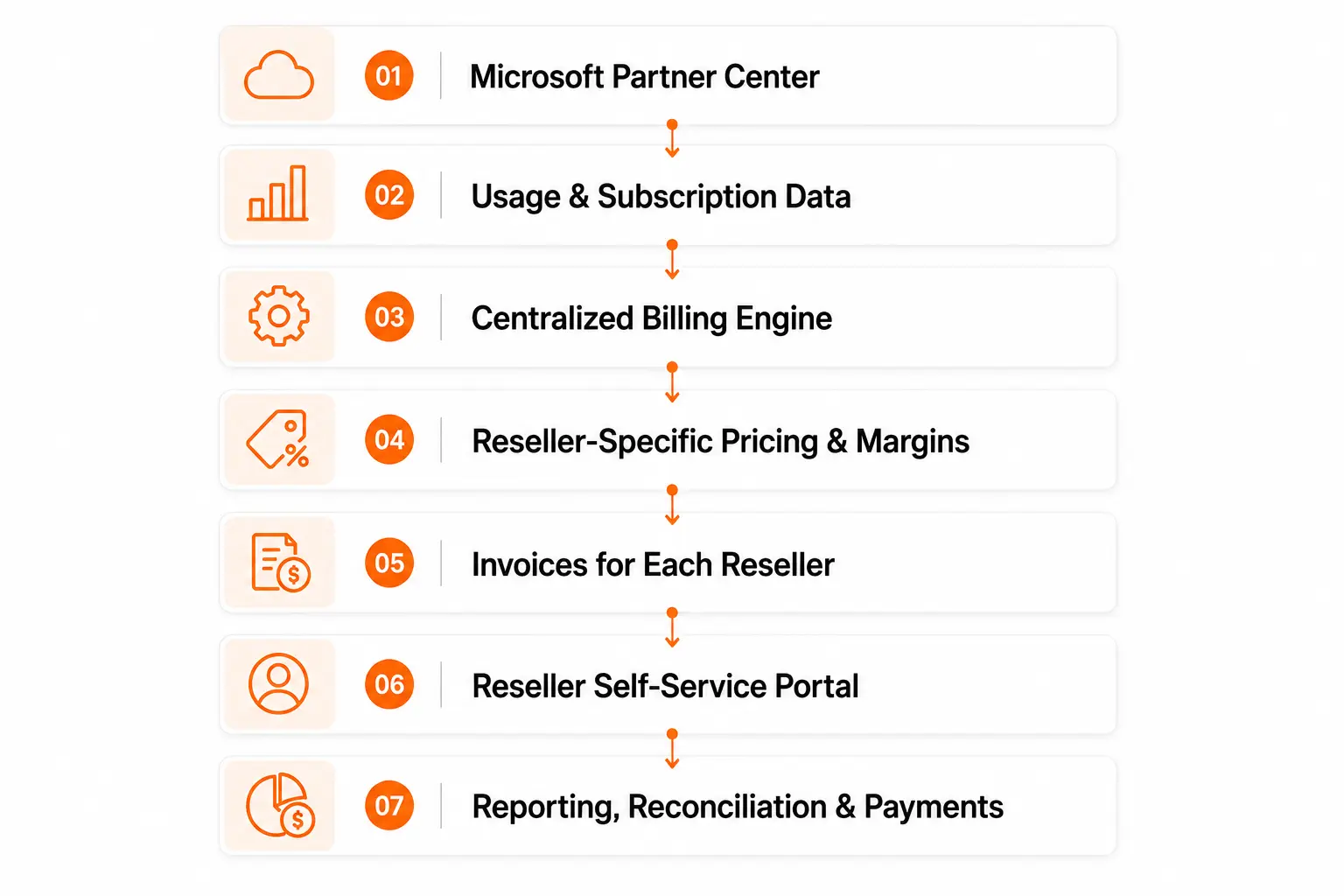
Standardizing the billing process makes it easier to support partner-specific pricing, billing preferences, and financial reporting without relying on manual work.
Key Features Every CSP Billing Platform Should Include
Not every billing platform is built for the demands of a multi-tier reseller business. While many platforms can generate invoices, indirect providers need a platform that supports the entire billing lifecycle, from usage reconciliation and pricing to invoicing, payment tracking, reporting, and financial reconciliation while handling partner-specific pricing and commercial terms and giving finance and operations teams complete visibility across the reseller network.
| Capability | How It Supports Multi-Tier Reseller Operations |
|---|---|
| Automated usage data ingestion | Continuously synchronizes usage and subscription data from Microsoft, eliminating manual imports. |
| Flexible pricing engine | Applies reseller-specific pricing, negotiated margins, discounts, and customer-specific agreements automatically. |
| Multi-tier hierarchy management | Supports distributor → reseller → customer relationships with separate pricing, billing, and reporting for each reseller. |
| Automated invoice generation | Generates accurate reseller invoices at scale using predefined billing rules, tax settings, and schedules. |
| Credit and adjustment management | Automatically processes upgrades, downgrades, cancellations, refunds, and promotional credits with a complete audit trail. |
| Multi-currency and tax support | Handles different currencies, exchange rates, and regional tax requirements across markets. |
| Reseller self-service portal | Gives partners access to invoices, consumption data, billing history, and payment information. |
| Reporting and analytics | Provides centralized visibility into billing performance, reseller activity, outstanding invoices, and revenue trends. |
| Platform integrations | Connects with Microsoft Partner Center and other business systems to automate data flow and maintain consistency. |
Benefits of Billing Automation for Indirect Providers
For indirect providers, billing automation goes far beyond replacing manual processes. By automating repetitive billing tasks and bringing pricing, subscriptions, invoicing, reconciliation, and reporting into a single platform, distributors can manage higher transaction volumes, more reseller relationships, and increasingly complex billing requirements while maintaining accuracy and free their teams to focus on higher-value activities instead of routine administrative tasks.
The operational difference becomes clear when comparing manual billing with an automated approach.
| Operational Area | Manual Billing Operations | Automated Billing Operations |
|---|---|---|
| Invoice generation | Time-consuming, repetitive preparation | Faster, rule-based generation at scale |
| Usage reconciliation | Manual validation across multiple sources | Automated reconciliation using synchronized data |
| Pricing management | Spreadsheet-based calculations | Centralized pricing rules applied consistently |
| Subscription changes | Manual processing of upgrades and renewals | Automated handling of lifecycle events |
| Reseller experience | Limited visibility into billing | Self-service access to invoices, usage, and history |
| Reporting | Static reports after month-end | Centralized dashboards with near real-time insights |
| Scalability | Requires additional resources as networks grow | Supports growth without proportional effort |
Faster Invoice Cycles
One of the first benefits distributors notice is a much faster billing cycle. Instead of spending days collecting usage data, reconciling accounts, validating pricing, and preparing invoices manually, automated workflows complete much of that work in the background. Finance teams can generate invoices more quickly while maintaining consistent billing across every reseller and customer.
Faster invoice generation also improves cash flow. When reseller partners receive invoices sooner, they can complete their own billing processes earlier, reducing payment delays and creating a more predictable revenue cycle for distributors.
Improved Billing Accuracy
Billing accuracy is critical in a multi-tier reseller ecosystem. Even small pricing or invoicing errors can create disputes, delay payments, and damage reseller confidence.
Automation applies pricing rules, subscription changes, taxes, credits, and billing adjustments consistently across every reseller. By reducing manual calculations and processing errors, finance teams spend less time investigating discrepancies and correcting invoices, allowing them to focus on improving operations and supporting reseller growth.
Better Reseller Experience
Billing is one of the touchpoints reseller partners interact with most often. Every invoice, usage report, payment update, or billing adjustment shapes their experience of working with a distributor. Delays, inaccuracies, or a lack of visibility can quickly lead to support requests and unnecessary back-and-forth.
Providing accurate invoices, timely billing updates, and self-service access to usage, invoices, and payment history gives reseller partners the information they need without relying on the distributor’s support team. That improves transparency, reduces routine support requests, and helps build stronger, long-term reseller relationships.
Greater Financial and Operational Visibility
When data is spread across multiple systems, finance and operations teams spend more time gathering information than acting on it.
Automation brings billing activity together in a single platform, making it easier to monitor invoice status, outstanding payments, reseller performance, billing exceptions, and revenue trends. With real-time visibility, teams can identify issues earlier, respond more quickly, and make decisions based on accurate, up-to-date information instead of manually compiled reports.
Scalable Growth Without Increasing Operational Complexity
Growth should not mean adding more manual work. Automated workflows continue to process pricing, subscriptions, invoicing, and billing changes consistently as the reseller network expands, allowing distributors to scale without increasing manual effort at the same pace.
The Business Impact of Billing Automation
With billing automation in place, indirect providers can:
- Generate accurate invoices faster across hundreds or thousands of reseller partners
- Standardize billing processes while supporting reseller-specific pricing, discounts, and commercial agreements
- Reduce manual reconciliation and administrative work throughout the billing cycle
- Give reseller partners greater transparency through self-service access to invoices, usage, and payment information
- Monitor billing performance from a centralized platform across the entire reseller ecosystem
- Scale reseller operations without proportionally increasing manual effort or headcount
Best Practices for Modern CSP Billing Operations
As reseller ecosystems grow, distributors need billing processes that can scale with the business. Standardizing key workflows helps reduce manual work, improve billing accuracy, and give finance and operations teams better visibility across the entire reseller network.
The following best practices can help indirect providers build more efficient, scalable billing operations that support continued business growth without adding unnecessary complexity.
Centralize Billing Operations
A centralized billing platform brings all of that information together in one place. Finance and operations teams can work from the same data, manage the entire reseller network more efficiently, reduce manual effort, and maintain greater consistency across every billing cycle. This approach also aligns with the shift toward integrated CSP operations discussed in our blog on The Future of CSP Growth: Fewer Tools, More Integrated Systems.
Standardize Pricing Rules Across Reseller Tiers
Different reseller partners may operate under different commercial agreements, but the underlying pricing logic should remain consistent and centrally managed. This reduces manual calculations and simplifies pricing updates without affecting reseller-specific margins.
Automate Usage Reconciliation
Automated reconciliation ensures invoices reflect the latest subscription activity while reducing the effort required to validate billing data before invoices are generated.
Enable Reseller Self-Service
Direct access to invoices, consumption reports, billing history, and payment information improves transparency while reducing routine support requests, freeing support teams for higher-value partner enablement.
Monitor Billing Performance Continuously
Month-end should not be the first time billing issues become visible. Continuous monitoring helps identify reconciliation issues, invoice exceptions, and payment delays before they affect reseller partners.
Maintain Comprehensive Audit Trails
Recording every pricing update, subscription change, and billing adjustment simplifies financial reporting, strengthens compliance, and makes it easier to investigate billing queries.
Related Reading
- The Future of CSP Growth: Fewer Tools, More Integrated Systems
- How to Automate Quote-to-Provisioning for Microsoft CSP
- What Microsoft CSPs Should Automate First: The Top 7 Workflows
- Azure Consumption Volatility: Why CSP Margins Are Becoming Harder to Predict
Final Thoughts
As Microsoft CSP ecosystems continue to grow, distributors need billing operations that can scale alongside their reseller networks. Automating billing not only simplifies invoicing and reconciliation but also improves partner experiences, reduces operational complexity, and provides the visibility needed to support long-term growth. The distributors that invest in modern billing infrastructure today will be better positioned to manage expanding partner ecosystems and adapt to evolving CSP requirements.
Ready to Modernize Your CSP Billing Operations?
CSP Control Center helps indirect providers automate multi-tier billing workflows, streamline reseller management, and gain greater visibility across the entire billing lifecycle, enabling them to support partner growth with confidence.
Book a demo to see how CSP Control Center can help simplify multi-tier reseller operations and scale your CSP business.
FAQs
What is CSP billing for distributors?
It is the process of managing usage, pricing, invoicing, reconciliation, taxes, and payments across multiple reseller partners from a single centralized platform, spanning the distributor, reseller, and end-customer tiers.
Why does manual CSP billing fail at scale?
Because each new reseller multiplies customers, subscriptions, pricing agreements, and usage data. Manual reconciliation and spreadsheets cannot keep pace, so errors and delays compound across billing cycles.
What is multi-tier billing in the CSP model?
Multi-tier billing manages the distributor to reseller to customer hierarchy, applying separate pricing, billing, and reporting to each reseller while keeping a single source of truth for usage and payments.
How does billing automation help indirect providers?
It speeds up invoice cycles, improves accuracy, gives resellers self-service visibility, centralizes financial reporting, and lets distributors grow their networks without adding proportional headcount.
What should distributors look for in a billing platform?
Automated Microsoft usage ingestion, a flexible pricing engine, multi-tier hierarchy management, automated invoicing, credit handling, multi-currency and tax support, a reseller portal, analytics, and Partner Center integration.
How can a distributor start modernizing its billing?
Begin by centralizing billing data and automating usage reconciliation and invoicing, then add reseller self-service and continuous monitoring so accuracy and visibility hold as the network grows.