


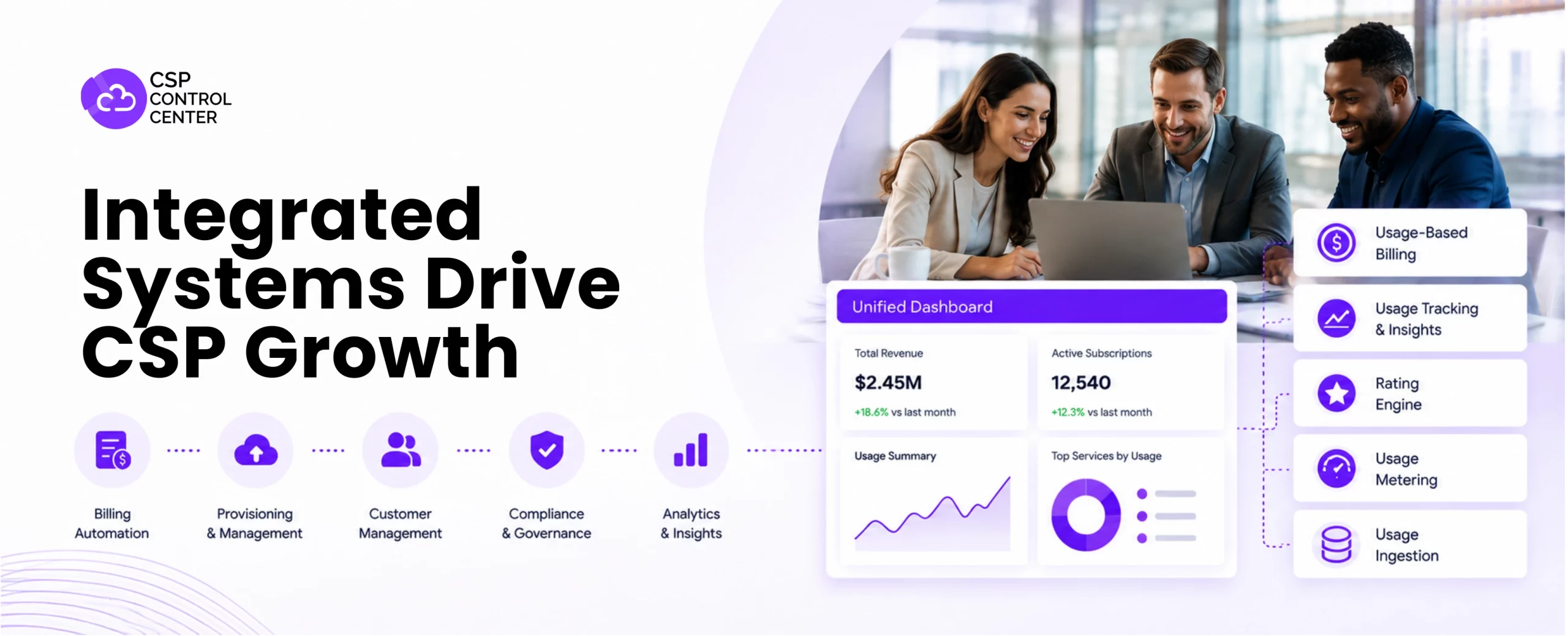
The fastest-growing Microsoft CSPs are reducing tool sprawl and adopting integrated CSP platforms to automate billing, provisioning, customer management, and compliance workflows. Instead of managing disconnected systems, leading CSPs are using unified operational platforms that connect Microsoft Partner Center, billing automation, reporting, and customer lifecycle management in real time. This shift helps CSPs improve operational efficiency, reduce billing errors, lower manual workload, and scale recurring revenue more effectively.
The Problem: Tool Sprawl Is Breaking CSP Operations
Most CSP businesses did not design their systems for scale; they assembled them over time. Tools were added as needs came up, often solving immediate problems without a clear view of how everything would fit together later. That approach works early on, but as the business grows, those same decisions start to create gaps, inconsistencies, and more manual work than the team can comfortably manage.
What Most CSP Stacks Look Like Today
A typical stack usually includes Microsoft Partner Center, a CRM, a billing platform, spreadsheets, and a set of manual workflows that bridge the gaps between them. Each tool solves a specific problem, but they do not really work together as one system.
This creates fragmentation across sales, finance, and operations, with data spread across multiple systems and no single place that shows the complete picture of the customer, subscription, or revenue lifecycle.
Where It Breaks
The breakdown usually starts with the data. Information is pulled from Microsoft Partner Center, moved into spreadsheets, adjusted manually, and then passed into billing or accounting systems. By the time invoices are generated, the data has already gone through multiple layers of handling and changes. As a result, billing mismatches become more frequent, reconciliation takes longer, and finance teams end up spending more time checking numbers than closing books.
At the same time, there is no clear, real-time view of margins or customer status. Pricing changes, usage shifts, and subscription updates do not flow through systems immediately, so teams are often working with delayed or incomplete information.
The Business Impact
The impact on the business is immediate. It shows up in a few clear ways: deal cycles slow because operations cannot keep pace, revenue leaks through billing errors and missed updates, and costs rise as scaling depends more on manual work.
Microsoft’s New Commerce Experience adds another layer of complexity. Subscription terms, cancellations, pricing changes, and Partner of Record validation all introduce workflows that need to be handled carefully. What used to be simple license reselling now requires ongoing lifecycle management.
Cloud adoption is accelerating this challenge. The global cloud computing market was estimated at USD 943.65 billion in 2025 and is projected to reach USD 3,349.61 billion by 2033, growing at a CAGR of 16.0%. This growth means more subscriptions, more usage-based billing, and significantly more operational complexity for CSPs.
Signs your tool stack is holding you back
- Billing requires manual adjustments every cycle
- Finance and operations work with different numbers
- Customer issues are discovered after invoicing
- Subscription changes take time to reflect across systems
- Reporting requires pulling data from multiple sources
Why Integration Is Now a Growth Strategy, Not Just an IT Decision
Earlier integration used to be seen as an operational improvement. Today, it plays a much larger role in how CSPs scale, respond to customers, and grow efficiently.
A fully integrated CSP environment connects billing, provisioning, customer management, compliance, and reporting within one operational framework. Instead of relying on disconnected tools and manual coordination, information moves seamlessly across the system, reducing delays, improving visibility, and creating a more consistent operational flow.
The single-pane-of-glass advantage goes far beyond having a cleaner dashboard. When teams can access tenant data, subscriptions, Azure usage, billing insights, and customer activity from one place, decision-making becomes faster and far more proactive.
Sales teams can identify upsell opportunities early instead of waiting for customer requests. Finance teams gain real-time visibility into margins instead of piecing reports together at the end of the billing cycle. Operations teams can track renewals, provisioning, and support activity before issues escalate. The result is not just better visibility, but a more responsive and scalable CSP business overall.
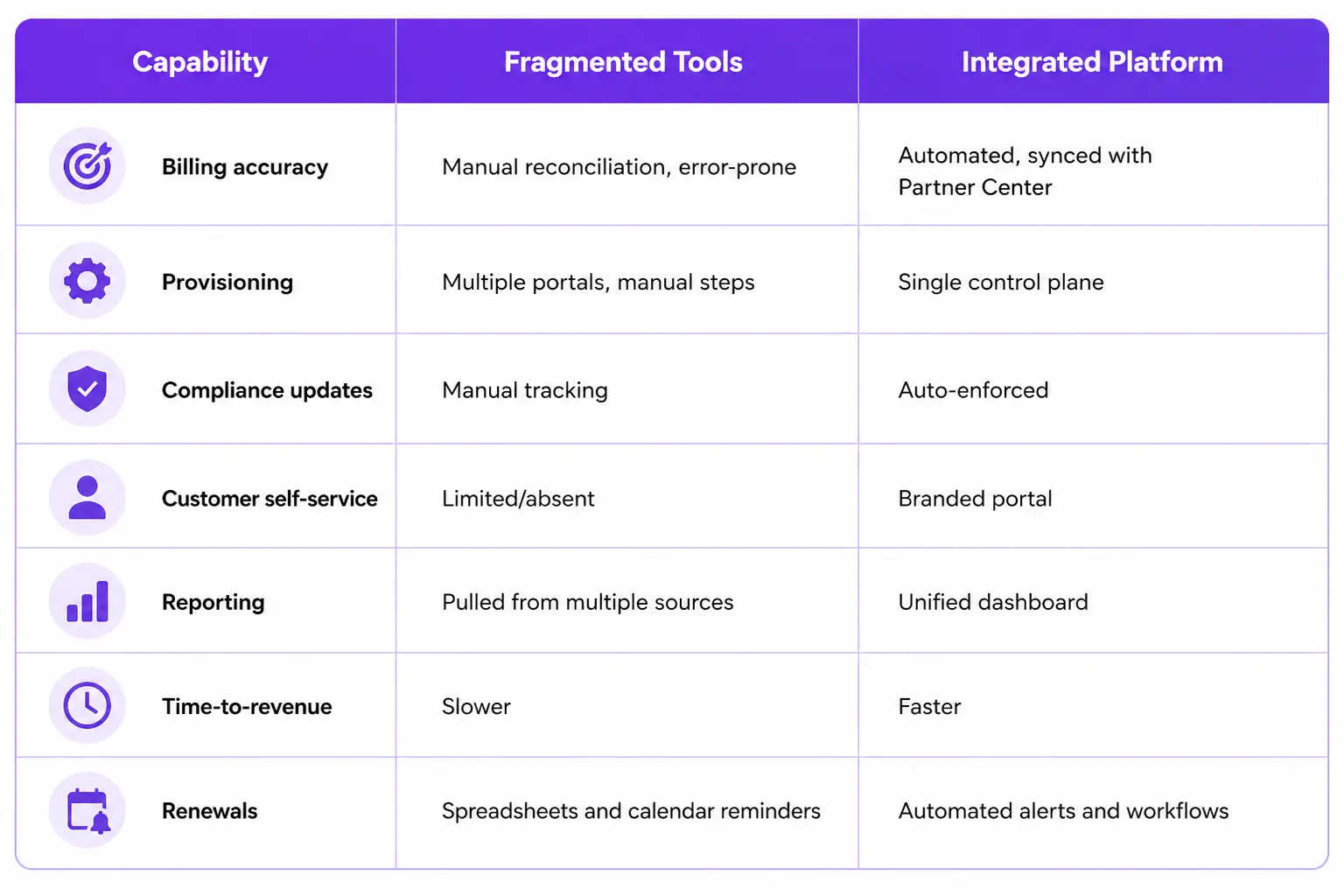
This is where the real business impact becomes visible: faster time-to-revenue, lower operational cost per customer, fewer billing disputes, and clearer visibility into where the next growth opportunity exists.
Instead of spending time fixing operational gaps, teams can focus on customer expansion, retention, and profitability.
Comparison: Fragmented Tool Stack vs Integrated CSP Platform
What Microsoft’s Own Program Changes Are Telling You
If there is one clear sign that manual processes are no longer sustainable, it is the pace at which the Microsoft CSP ecosystem continues to evolve.
In December 2025, Microsoft enforced Partner of Record (POR) validation via API, which means invalid POR assignments now block order submissions outright. There is no grace period or manual workaround, so if your system does not validate POR assignments automatically, orders simply do not go through.
In January 2026, Microsoft retired the legacy MCA attestation API and the Partner Center UX-based attestation experience, replacing them with a new enhanced attestation API. CSPs that did not migrate in time now need their new customers to directly accept the MCA before any order can be placed. For CSPs relying on manual processes, every new onboarding effectively becomes a compliance checkpoint that has to be handled manually.
Each of these changes introduces new operational requirements for partners working with fragmented systems, often resulting in more manual effort. Teams have to update workflows, validate data separately, and maintain compliance across multiple disconnected platforms.
For CSPs operating on integrated systems, the experience looks very different. Platform-level updates flow directly into existing workflows, reducing the need for manual intervention. Instead of rebuilding processes every time requirements change, the system adapts as part of normal operations.
The compliance cost of fragmentation is high. Missed Partner of Record assignments can block orders, and failed MCA attestations can delay or stop customer onboarding. These are not rare exceptions; they are everyday operational risks.
At the same time, Microsoft continues to evolve the CSP program at a rapid pace, introducing new requirements, validations, and policy changes across billing, provisioning, and compliance workflows.
The challenge for CSPs is becoming increasingly clear as operational complexity continues to grow across billing, compliance, provisioning, and customer management workflows. Keeping pace with that complexity becomes extremely difficult when teams are still relying on manual coordination across disconnected systems and tools.
“When Microsoft changes the rules, integrated systems adapt quickly. Fragmented stacks require teams to figure it out manually.”
What a High-Growth CSP Operating Model Actually Looks Like
High-growth CSPs no longer run their business directly out of Microsoft Partner Center. They treat it as a data source, with the operational layer built on top of it. Microsoft Partner Center remains essential for transactions and administrative control, but it was never built to manage the entire customer lifecycle or support complex operational workflows at scale.
Capabilities such as advanced billing automation, real-time margin visibility, customer lifecycle management, and multi-layered reporting typically require a more integrated operational platform beyond Partner Center alone.
Architecture of an integrated CSP platform
- Unified billing engine synced directly to Partner Center
- CRM-connected workflows that trigger billing and provisioning
- Automated reconciliation without end-of-cycle rebuild
- Real-time pricing with custom markup controls
- Self-service customer portal for subscriptions and invoices
- Accounting and PSA integrations so finance and ops work from the same numbers
What real-time alignment looks like in practice
When these systems are connected, the day-to-day experience starts to change, and those changes add up over time. A subscription change updates instantly across billing, reporting, and customer-facing systems without requiring teams to manually reconcile data across multiple platforms.
Renewal workflows become proactive instead of reactive, with automated triggers at 90, 60, and 30 days before expiry rather than relying on someone to monitor spreadsheets manually. Even changes introduced by Microsoft, such as new SKUs or pricing updates, can flow directly into the pricing catalog automatically instead of depending on manual update cycles that create delays and inconsistencies.
What an integrated CSP platform handles without human intervention:
- Subscription provisioning and license changes
- Azure usage-based billing reconciliation
- Renewal alerts and automated workflows
- Custom pricing and markup application
- Invoice generation at the entitlement level
- Compliance validation for GDAP, MCA, and POR
- Real-time margin and revenue reporting
How to Start the Transition — Three Moves That Matter
Consolidation does not mean rebuilding the entire operational stack all at once. It starts with identifying where disconnected systems are creating the biggest operational inefficiencies and addressing those gaps systematically.
The goal is not the immediate replacement of every system but creating a more connected operational foundation that can scale as the business grows.
Move 1: Diagnose where your operations actually break today
Start with billing and reconciliation rather than moving directly into evaluating new tools. Ask your team three practical questions: where is Partner Center data being exported and manually reformatted, where are invoices being adjusted before they are sent to customers, and where do finance and operations teams regularly disagree on the numbers?
The answers usually reveal exactly where operational inefficiencies are concentrated. Those areas often represent the highest-impact opportunities for integration, where consolidation can reduce manual effort, improve accuracy, and deliver measurable operational gains quickly.
Move 2: Stop running your business out of Partner Center
This is one of the most common patterns limiting CSP growth. Because Partner Center sits at the core of CSP transactions and account management, many partners allow it to become the place where every operational task happens. But Partner Center is fundamentally a data and transaction layer, not a complete operational system.
CSPs that scale effectively treat Partner Center as a source of operational data rather than the center of day-to-day execution. They use that data to power automated workflows across billing, renewals, customer management, reporting, and pricing operations.
Instead of relying on teams to log into Partner Center manually to check statuses, manage renewals, or update pricing, scalable CSPs route that information into systems designed to automate actions, trigger workflows, and maintain operational consistency across the business.
Move 3: Consolidate billing and provisioning first
For most CSPs, billing and provisioning is the highest ROI starting point in any consolidation effort. For most partners, the workflow still involves CRM exports feeding into a billing platform, followed by manual spreadsheet adjustments before invoices are reviewed and finalized. Every additional handoff increases the likelihood of delays, inconsistencies, and reconciliation issues.
The objective is to replace that fragmented process with connected workflows where data moves through the system once and remains consistent across billing, provisioning, and reporting operations. Consolidating these functions first can remove a significant portion of the manual reconciliation work, reduce billing disputes, and eliminate many of the operational bottlenecks consuming team capacity today.
More importantly, it creates the operational foundation that future automation, reporting, compliance, and customer lifecycle processes can build upon.
How to Evaluate Whether to Add a Tool or Replace Several
Many CSPs eventually reach a point where they think of adding another tool to solve a specific operational problem. That is often the moment when the stack starts becoming increasingly difficult to manage.
Once you have identified where your operations are breaking down and committed to consolidating core workflows, the next practical step is defining what your platform actually needs to support. Before you add any new tool, ask these three questions:
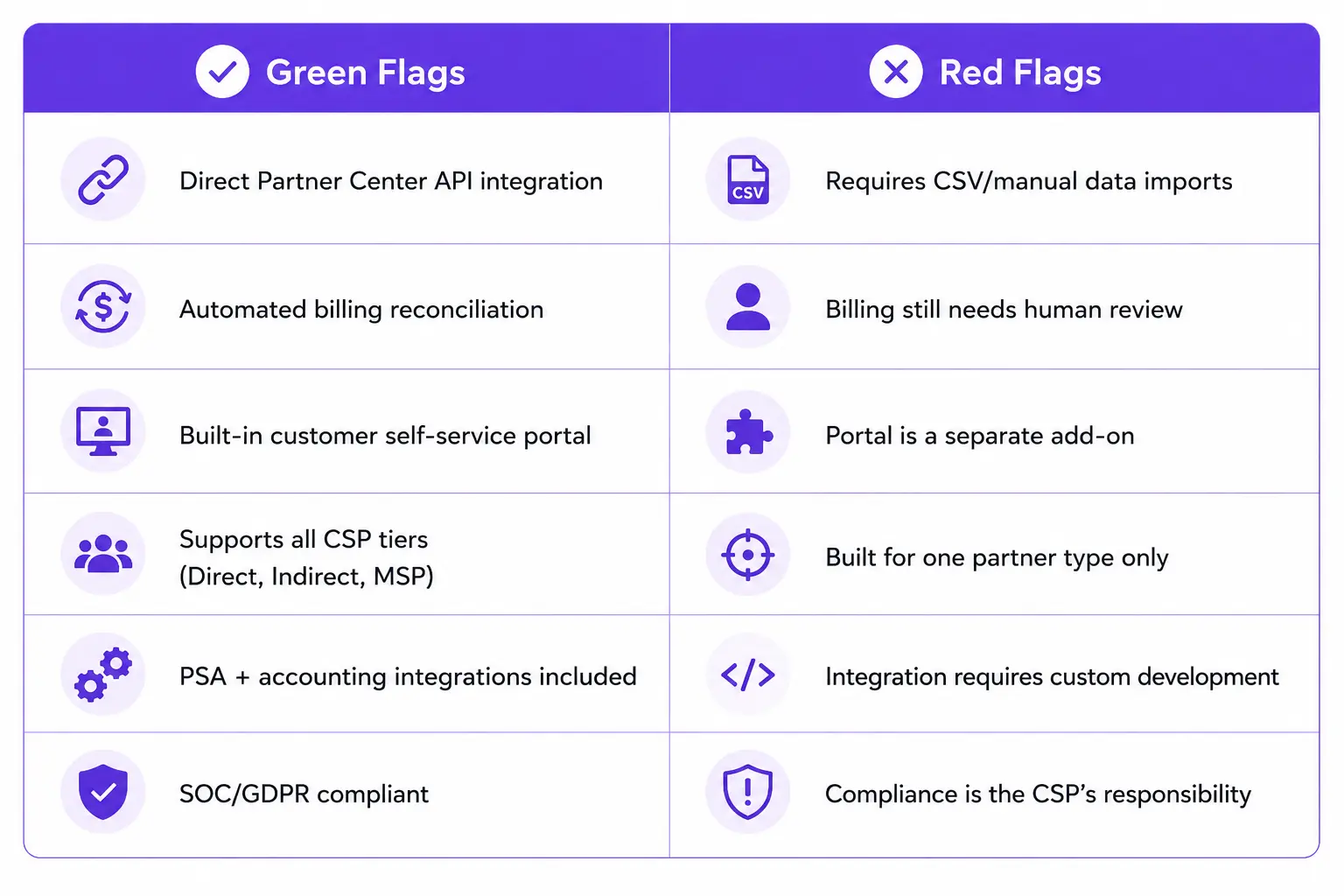
- Does it connect directly to Microsoft Partner Center via API, or does it require manual data exports?
- Does it reduce human touchpoints in billing, provisioning, or compliance, or simply move them elsewhere?
- Can it scale to support three times your current customer base without requiring proportional increases in headcount?
What to look for in an Integrated CSP Platform
When evaluating platforms, the objective is not to find one that simply offers more features. It is to identify a platform that removes the manual effort between the processes you already rely on every day.
Direct Partner Center Integration
Your platform should connect directly with Partner Center through APIs rather than relying on manual exports or delayed sync processes. This ensures that subscription changes, license updates, usage data, and transactional information flow directly into your billing, reporting, and operational systems without requiring teams to move data manually between platforms.
Real-time integration reduces lag, improves accuracy, and removes many of the reconciliation issues that emerge when different systems are working from outdated or inconsistent information.
Customer Self-Service Portal
A strong CSP platform should give customers the ability to manage routine tasks independently instead of relying on support teams for every request. That includes viewing invoices, monitoring Azure spend, managing subscriptions, and submitting service changes through a dedicated self-service portal.
A white-labeled customer portal improves the overall service experience while reducing the operational burden on internal teams. It helps resolve requests faster, lowers support volume, and creates a more scalable customer experience without requiring additional headcount. If you want a deeper look at what a well-built self-service portal should include and how it changes the customer relationship, read this guide on customer self-service portals.
PSA and Accounting Integrations
Billing data should move directly into PSA and accounting systems without requiring manual exports, spreadsheet manipulation, or repeated imports between platforms. Strong integrations with tools such as Autotask, QuickBooks, and Xero help ensure finance and operations teams are working from the same source of truth.
When billing and accounting workflows are properly connected, reporting becomes more accurate, and the reconciliation effort drops significantly.
Compliance Support
The Microsoft CSP program requires continuous compliance across areas such as GDAP, MCA attestation, and Partner of Record validation. Managing these requirements manually becomes increasingly difficult as program rules evolve and operational complexity grows.
A platform with built-in compliance support helps automate this responsibility by flagging issues before they disrupt orders, embedding compliance checks into operational workflows, and adapting processes as Microsoft updates its requirements.
Multi-Model Flexibility
CSP businesses rarely stay the same for long. Many evolve over time, moving from Indirect Reseller to Direct Bill, expanding into Indirect Provider models, or growing from a single-market MSP into a multi-region operation with more complex billing and service requirements.
A platform built with multi-model flexibility ensures your operational systems can adapt alongside that growth. Support for Direct Bill, Indirect Provider, and Indirect Reseller models within a single platform helps prevent costly migrations or workflow disruptions when the business model changes. The right platform should support your growth, not become a limitation as your CSP business scales.
Green flags vs. Red flags when evaluating a platform
The Takeaway
The future of CSP growth is not about adding more operational layers. It is about reducing inefficiencies between the systems and processes you already depend on. Complexity within the Microsoft ecosystem will continue to grow across billing, compliance, provisioning, and customer management. The real differentiator will be how effectively your operational systems are built to absorb and manage that complexity at scale.
CSPs that reduce tool sprawl and invest in integrated operational systems are creating a more efficient path to growth. They lower the cost of scaling, improve execution speed, and build an operational foundation that can support increasing complexity without proportionally increasing overhead.
CSPs that continue relying on disconnected tools often experience the opposite effect, where growth introduces more manual effort, more reconciliation work, and greater operational strain.
CSP Control Center is built specifically for this operational model, providing a dedicated billing and subscription management platform that brings together the workflows Microsoft CSP partners rely on every day. Unifying billing, provisioning, customer management, compliance, and reporting processes, it helps replace fragmented operations with a more connected and scalable system.
Book a demo to see what CSP operations look like when core workflows are fully connected.
Frequently Asked Questions
Why does Microsoft CSP billing become difficult at scale?
Microsoft CSP billing becomes difficult at scale because growing customer accounts increase Azure usage data, subscription changes, renewals, SKUs, and compliance complexity. Manual reconciliation and spreadsheet-based billing create errors, revenue leakage, and operational delays. Automated CSP billing platforms help streamline reconciliation, improve billing accuracy, and support scalable Microsoft CSP operations.
Is Microsoft Partner Center enough to run a CSP business?
Microsoft Partner Center is essential for Microsoft CSP operations, but it is not designed to manage a CSP business end-to-end. It lacks advanced billing automation, real-time margin visibility, customer lifecycle management, and automated renewal workflows. High-growth CSPs use integrated CSP management platforms alongside Partner Center to automate billing, provisioning, reporting, and compliance while scaling operations efficiently.
How do integrated systems improve CSP margins?
Integrated CSP systems improve margins by reducing billing errors, revenue leakage, and manual operational costs. Automated billing, real-time reconciliation, accurate SKU mapping, and workflow automation help CSPs increase profitability while scaling efficiently. By reducing manual effort and operational overhead, integrated CSP platforms enable faster growth with higher recurring revenue margins.