



TL;DR
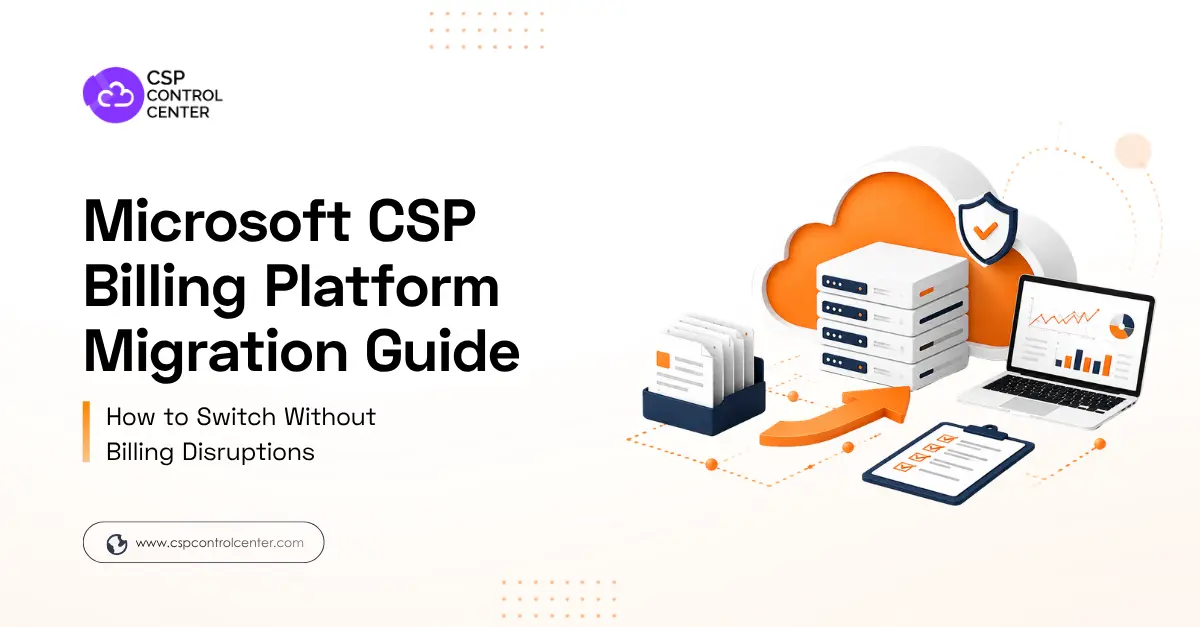
Migrating Microsoft Cloud Solution Provider (CSP) billing platforms without revenue leakage or customer friction requires running parallel billing cycles, validating subscription mappings against Partner Center, and conducting a phased cutover. Partners that plan the migration in stages, reconcile invoices before go-live, and keep the legacy platform available during transition avoid the billing errors and customer disputes that derail most migrations.
Key Takeaways
- Successful CSP billing migrations are driven by planning, not speed.
- Parallel billing is the most effective way to prevent invoice discrepancies.
- Clean, validated billing data significantly reduces migration risk.
- Phased migrations minimize disruption compared to a full cutover.
- Historical billing records should be preserved for reporting and compliance.
- Modern billing platforms improve automation, scalability, and financial visibility.
Why More Microsoft CSPs Are Replacing Their Billing Platforms
For many Microsoft CSPs, the decision to migrate to a new billing platform is not driven by dissatisfaction with existing software. They replace it because their business has outgrown it.
As CSP businesses expand, billing operations become significantly more complex. Managing hundreds or thousands of customer subscriptions, supporting multiple reseller partners, tracking Azure consumption, handling Microsoft licensing changes, and maintaining billing accuracy all place increasing demands on finance and operations teams. Processes that once worked well for a smaller customer base often become difficult to sustain as transaction volumes increase.
The Microsoft Cloud Solution Provider ecosystem has evolved rapidly, adding new layers of complexity. The introduction of the New Commerce Experience (NCE) brought new commitment terms, renewal schedules, cancellation policies, and pricing structures that require more sophisticated billing workflows. At the same time, customers expect greater transparency, faster invoicing, and accurate usage-based billing across multiple cloud services.
As their business grows, many CSPs try to manage by adding more spreadsheets, manual checks, or standalone tools to their existing billing process. While these workarounds may solve an immediate problem, they often make billing harder to manage over time. Finance teams spend more time reconciling invoices, support teams handle more billing-related questions, and reporting becomes increasingly difficult because critical billing data is spread across multiple systems.
Business leaders also need better visibility into billing performance. According to Flexera’s 2025 State of the Cloud Report, 84% of organizations identify managing cloud spend as their biggest cloud challenge, underscoring the need for automated billing and financial visibility.
Modern billing platforms provide real-time reporting, automated reconciliation, and centralized dashboards that help teams monitor performance and identify issues early. As businesses grow, migrating to a modern billing platform becomes a natural step toward improving billing accuracy and reducing manual work.
Before You Begin: Questions Every CSP Should Answer
A billing platform migration starts well before any data is exported or new software is installed. Before you select a timeline or configure a platform, the business needs clear answers to three questions.
Why are you migrating?
Every organization migrates for a different reason. Some want to eliminate manual billing work, while others need stronger reporting, support for more complex Microsoft licensing models, or a platform that can keep up as the business grows.
Understanding the primary reason for the migration helps determine what to prioritize. An organization looking to reduce manual effort may focus on automation, while one preparing for growth may prioritize scalability, reseller management, or advanced reporting capabilities. Defining those priorities early makes it easier to evaluate platforms and measure whether the migration delivers the expected results.
Who owns the migration project?
Successful migrations require collaboration across multiple teams. Finance, operations, IT, customer support, and business leadership all have different responsibilities during the migration process. Assigning clear ownership for each phase reduces confusion and improves accountability throughout the project.
What does success look like after migration?
Before the migration begins, decide how you will measure its success. That could mean generating invoices faster, reducing billing disputes, spending less time on manual reconciliation, or giving teams better reporting. Defining these outcomes early helps everyone work toward the same goals and makes it easier to evaluate whether the migration delivered the expected improvements.
What Should Be Migrated to the New Billing Platform?
Billing platform migration involves far more than transferring customer records. A successful migration preserves the billing rules, financial records, integrations, and historical data that keep billing operations running accurately.
The exact scope varies by business, but most Microsoft CSPs should evaluate the following components before the migration begins.
| Billing Component | Why It Matters |
|---|---|
| Customer accounts | Maintain billing continuity and customer relationships |
| Active subscriptions | Prevent service disruption during migration |
| Pricing and reseller agreements | Preserve billing accuracy and contractual pricing |
| Historical invoices | Support audits, reporting, and customer reference |
| Usage and consumption data | Ensure accurate usage-based invoicing |
| Payment history | Maintain customer balances and payment records |
| Taxes and credits | Preserve financial reconciliation and compliance |
| Reports and dashboards | Maintain operational visibility and business insights |
| Integrations | Ensure uninterrupted communication with connected systems |
It is equally important to determine what should not be migrated. Obsolete customer records, inactive subscriptions, duplicate accounts, and outdated pricing configurations add unnecessary complexity and increase migration effort without delivering business value.
Treat the migration as an opportunity to improve data quality rather than simply moving every existing record into a new system. Starting with accurate, standardized billing data makes every stage of the migration process smoother and significantly reduces the likelihood of billing discrepancies.
A Step-by-Step Microsoft CSP Billing Migration Framework
Migrating a Microsoft CSP billing platform takes more than moving data from one system to another. It involves careful planning, thorough testing, and a phased rollout to keep billing accurate and minimize disruption for both your team and your customers.
Successful CSPs treat the migration as a phased rollout rather than a single cutover. A single cutover looks faster, but it concentrates every point of failure into one event. Validating each stage before starting the next lets teams catch issues while they are still small.
Step 1: Assess Your Current Billing Environment
Before moving any data or configuring a new platform, develop a clear understanding of your existing billing environment.
Start by reviewing your current billing environment and documenting:
- Customer accounts and active subscriptions
- Pricing rules and billing cycles
- Reseller agreements and commercial terms
- Reporting requirements
Systems connected to your billing platform, including Microsoft Partner Center, CRM, ERP, accounting software, payment gateways, and customer portals
Next, identify the parts of the billing process that need the most attention, such as:
- Invoice reconciliation
- Usage validation
- Subscription management
- Financial reporting
- Any workflow that relies heavily on manual work or regularly results in billing errors
Understanding how your current billing process works also helps define what should be included in the migration. Instead of recreating every existing workflow, you can simplify processes, eliminate unnecessary steps, and move to a platform that’s easier to manage as the business grows.
Step 2: Clean and Standardize Billing Data
A successful billing migration starts with clean, reliable data. If outdated or incorrect information is moved into the new platform, the same billing issues are likely to follow.
Review customer records, subscription details, pricing information, and financial data before the migration begins. As part of this review, make sure to:
- Remove duplicate customer records.
- Update incomplete or outdated customer information.
- Archive inactive subscriptions where appropriate.
- Verify pricing configurations and reseller-specific pricing rules.
- Validate tax settings, billing contacts, and customer details.
Step 3: Configure the New Billing Platform
Before importing production data, configure the new billing platform to match the way your business operates. This is the time to set up the rules, workflows, and permissions that will govern day-to-day billing.
Configure the following before the migration:
- Pricing models and reseller-specific pricing rules
- Invoice templates and billing cycles
- Tax settings and financial rules
- Reseller hierarchies
- User roles and permissions
- Approval workflows
Wherever possible, automate routine billing activities such as:
- Invoice generation
- Payment tracking
- Usage reconciliation
- Financial and operational reporting
Step 4: Migrate Data in Phases
Avoid treating the migration as a single large-scale event. A phased rollout gives teams time to validate each stage before moving to the next, reducing the risk of billing errors and operational disruption.
A typical phased migration might look like this:
- Prepare the foundation – Customer accounts, pricing structures, reseller hierarchies, and billing configurations
- Move historical records – Invoices, payments, credit notes, and financial reports
- Transition live billing – Active subscriptions, usage history, and remaining production data
Step 5: Validate Every Integration
A billing platform does not operate on its own. It relies on multiple systems to support provisioning, finance, customer management, and reporting, so every integration should be tested before the new platform goes live. This is especially important if you’re also automating your quote-to-provisioning workflow, where billing and provisioning need to stay tightly synchronized.
Before launch, verify that integrations with Microsoft Partner Center, CRM platforms, ERP systems, accounting software, payment gateways, and reporting tools are working as expected. Confirm that subscription updates, usage data, invoices, payments, and financial records flow correctly between systems.
As part of integration testing, make sure to:
- Validate Microsoft Partner Center REST API authentication, token refresh handling, and rate-limiting thresholds.
- Perform bidirectional sync tests between the billing platform and PSA/ERP systems to verify seat count alignment.
- Run mock transactions through payment gateways to confirm payment processing, tokenization, and auto-settlement workflows.
- Test automated invoice emails to ensure successful delivery to customers.
Step 6: Run Parallel Billing
Running parallel billing is one of the most effective ways to reduce migration risk. Instead of switching to the new platform immediately, run both the existing and new billing platforms in parallel for one or more billing cycles. This allows you to compare results using the same customer data before relying on the new system for production billing.
During parallel billing, validate the following:
- Generate complete monthly billing runs from both platforms using identical live customer data.
- Compare line-item invoice totals, prorated seat adjustments, Azure consumption calculations, tax calculations, discounts, credits, subscription changes, and currency conversions.
- Investigate every discrepancy, including small rounding differences, to confirm that pricing and rating rules are working as expected.
- Continue running both platforms until financial results match consistently across the entire customer base.
Parallel billing adds effort during the migration, but it is the cheapest place to find a pricing error. Resolving discrepancies before cutover prevents the invoice disputes, credit notes, and manual corrections that follow a bad first billing run.
Step 7: Go Live with Continuous Monitoring
Once testing has been completed successfully, begin moving customers to the new billing platform in phases rather than all at once. Starting with a smaller group of customers or reseller partners allows teams to validate billing accuracy, monitor system performance, and refine operational workflows before expanding the rollout.
During the initial rollout, closely monitor:
- Invoice generation and delivery
- Subscription updates
- Usage synchronization
- Payment processing
- Customer support requests and billing-related issues
Put clear escalation procedures in place so issues can be investigated and resolved quickly before additional customers are migrated.
Go-live isn’t the end of the migration. Continue monitoring billing performance, reviewing operational workflows, and making incremental improvements during the first few billing cycles. This helps ensure the new platform delivers the accuracy, efficiency, and scalability the migration was intended to achieve.
Where CSP Billing Migrations Often Go Wrong
Most billing migration issues trace back to gaps in planning, testing, or validation that could have been caught earlier. These are the failure points that come up most often, and what to do about each one.
Invoice Discrepancies
The risk: Incorrect invoices can lead to customer complaints, payment delays, and time-consuming manual corrections.
How to reduce the risk: Keep both billing platforms running in parallel until invoice totals match consistently. Validate line-item charges, Azure usage, taxes, discounts, credits, and subscription changes before switching customers to the new platform.
Incorrect Subscription Mapping
The risk: Active subscriptions may not be mapped correctly during migration, causing issues with NCE commitments, auto-renewals, add-on licenses, or customer provisioning. This can result in service disruptions, unbilled usage, or incorrect invoices.
How to reduce the risk: Reconcile your billing platform with Microsoft Partner Center using API-based validation wherever possible. Verify that every subscription, tenant, renewal status, NCE commitment, and offer mapping has been migrated correctly before completing the final cutover.
Pricing Inconsistencies
The risk: Custom pricing, reseller-specific discounts, multi-tier markups, or currency conversion rules may not be migrated correctly. This can lead to incorrect invoices, customer disputes, and revenue leakage.
How to reduce the risk: Review and validate all non-standard pricing rules before migration. Test custom price schedules, reseller pricing, discounts, taxes, and currency rules in a sandbox environment, then verify the results before migrating live customer accounts.
Missing Historical Records
The risk: Historical invoices, credit notes, payment records, or transaction history may not migrate completely, making audits, tax reporting, financial reconciliation, and customer support more difficult.
How to reduce the risk: Verify that all historical billing and payment records have been migrated successfully before go-live. Compare financial records with your accounting system, and keep the legacy billing platform available in read-only mode until all audit, compliance, and customer support requirements have been met.
Low User Adoption
The risk: Finance, sales, and support teams may struggle to use the new billing platform, leading to slower billing cycles, processing errors, and increased support requests during the transition.
How to reduce the risk: Provide role-based training before go-live so each team understands the workflows relevant to their responsibilities. Support the rollout with clear documentation, quick-reference guides, and step-by-step instructions for common tasks such as seat changes, custom invoicing, credit notes, and payment processing.
Comparison: Manual vs. Automated CSP Billing Platform Migration
Not all billing migrations follow the same approach. Some organizations rely heavily on spreadsheets, manual reconciliation, and disconnected tools, while others use modern billing platforms with built-in automation and integration capabilities.
| Migration Factor | Manual Migration | Automated Billing Platform Migration |
|---|---|---|
| Data validation | Manual verification using spreadsheets | Automated validation workflows and consistency checks |
| Subscription mapping | Spreadsheet-based reconciliation | Direct synchronization with Microsoft Partner Center |
| Invoice reconciliation | Manual comparison of invoice outputs | Automated reconciliation across billing cycles |
| Azure usage synchronization | Manual imports and validation | Continuous synchronization of Azure consumption data |
| NCE subscription management | Manual tracking of commitments and renewals | Automated management of the complete NCE lifecycle |
| Migration visibility | Limited visibility across multiple tools | Centralized dashboards, audit trails, and migration tracking |
What to Look for in Your Next Microsoft CSP Billing Platform
When evaluating a new billing platform, look beyond standard features and assess how well it supports migration, integration, and future growth.
Choose a platform that can:
- Import historical billing data to preserve invoices, payment records, and reporting history.
- Integrate natively with Microsoft Partner Center to keep subscriptions, licensing, and provisioning synchronized.
- Support parallel billing so invoices can be validated before the final cutover.
- Handle Azure consumption and NCE subscriptions without requiring manual intervention.
- Automate billing workflows, including invoice generation, usage reconciliation, and payment tracking.
- Provide real-time reporting into revenue, billing performance, and financial operations.
- Scale as your business grows, supporting larger customer bases, reseller networks, and evolving Microsoft licensing models.
CSP Billing Migration Readiness Checklist
Before migrating to a new billing platform, make sure you have completed the following steps:
- Define your migration goals and how you will measure success.
- Review customer accounts, subscriptions, pricing, and billing data.
- Clean and validate billing records before migration.
- Back up all critical billing and financial data.
- Configure the new billing platform, pricing rules, and billing workflows.
- Test integrations with Microsoft Partner Center, CRM, ERP, accounting, and payment systems.
- Run parallel billing to verify invoices, Azure usage, taxes, discounts, and pricing.
- Prepare and document a rollback plan in case issues arise.
- Train finance, operations, sales, and support teams on the new platform and workflows.
- Closely monitor the first few billing cycles after go-live.
Migrating to a new Microsoft CSP billing platform is about more than replacing software. Done well, it takes manual work off the finance team, improves invoice accuracy, and gives the business billing infrastructure that holds up as it grows.
Related Reading
- 7 Signs You Need to Invest in Billing Automation for Your Microsoft CSP Business
- Build vs. Buy: Develop Your Own CSP Billing Platform?
- Essential Integrations for Microsoft CSPs: Automating End-to-End Operations Seamlessly
- Microsoft CSP Billing Benchmarks 2026: What High-Growth Partners Do Differently at Scale
How CSP Control Center Supports Billing Migrations
CSP Control Center (C3) helps Microsoft CSPs simplify billing migrations with automated billing workflows, native Microsoft integrations, Azure usage reconciliation, subscription management, and centralized reporting. The platform helps reduce manual work during migration while supporting more efficient billing operations after go-live.
Planning a billing platform migration? Book a demo to see how C3 can help you migrate with confidence and scale more efficiently.
Frequently Asked Questions
How long does a Microsoft CSP billing platform migration typically take?
Most Microsoft CSP billing migrations take six to twelve weeks from planning to full cutover. Partners with a few hundred subscriptions and standard integrations often finish in four to six weeks, while those migrating several years of historical invoices, custom pricing rules, and multiple connected systems should plan for a full quarter. Parallel billing usually accounts for one to two billing cycles of that timeline.
Can I migrate historical invoices and payment records?
Yes. Most modern CSP billing platforms support the migration of historical invoices, payment records, credit notes, and customer balances to maintain reporting continuity and compliance.
Should I run parallel billing before switching platforms?
Yes. Running parallel billing allows you to compare invoices and billing data across both systems, helping identify discrepancies before the final cutover.
Will customers notice a billing platform migration?
They should not. If subscription mappings are reconciled against Partner Center, pricing rules are validated, and parallel billing confirms that invoice totals match before cutover, customers keep receiving the same invoices on the same schedule. Billing disruption during a migration is almost always a symptom of skipped validation rather than of the migration itself.
What should happen to the old billing platform after go-live?
Keep it available in read-only mode until every audit, tax reporting, and customer support requirement has been met. Historical invoices, credit notes, and payment records are often needed months after cutover, and retaining read-only access is far cheaper than reconstructing those records later.