 CSP Control Center
 CloudEvents
 CloudLabs
 SaaSify

High-growth CSP partners in 2026 outperform others by building billing systems that are automated end to end, continuously reconciled, and tightly integrated with their CRM and finance stack.
At scale, the difference is not better tools, but it is better system design. The best partners reduce billing cycle time from days to hours, eliminate recurring reconciliation errors, and make every charge explainable in real time.
This blog breaks down what actually changes as CSP billing scales. It covers why most billing systems tend to fail beyond a certain point, what high-growth partners do differently, and the benchmarks that define a stable billing system in 2026. It also looks at reconciliation in detail, since that is where most systems either hold up or break.
Why CSP Billing Is Now a Growth Lever
Most CSP partners treat billing as a back-office function. They think it is something that the finance team handles at month-end, with spreadsheets, exported CSVs, and a few hours of manual reconciliation. As the business grows, this model does not work anymore.
According to IDC, for every $1 of Microsoft revenue, services partners earn $8.45. Microsoft Cloud revenue reached $49.1 billion in the quarter ended September 30, 2025, up 26% year over year. The volume flowing through the CSP channel has never been higher, and the billing systems managing that volume need to match that scale.
In today’s environment, CSP billing sits at the intersection of four critical functions simultaneously-
- Usage data flowing in from Microsoft Partner Center,
- Pricing logic applied across hundreds of SKUs and bundle configurations
- Customer contracts with varying terms, commitment tiers, and renewal dates
- Financial reporting that feeds directly into your P&L, cash flow projections, and investor reporting
When all these functions are connected and automated, billing becomes a growth accelerator. Revenue comes in faster, cash flow becomes predictable, and you finally have a real-time view of margins instead of figuring them out after the damage is done.
When these four functions are disconnected, everything breaks in slow motion. Revenue leaks quietly and compounds over time. Cash flow gets delayed every single cycle. Customer disputes become a structural feature of the business rather than an exception. And margin erodes in ways that are genuinely difficult to trace, because no single system holds the full picture.
CSP partners that addressed this early are not just operating more efficient billing systems. They are growing faster, retaining enterprise customers more consistently, and shortening deal-to-cash cycles in ways that directly strengthen working capital. At scale, billing is not a support function, it is a core part of the revenue engine.
The 2026 Reality: Why Most CSP Billing Systems Break at Scale
Scaling from 50 customers to 500 is not a linear operational challenge. With Microsoft CSP program requirements tightening in 2026, the operational bar for partners has never been higher. Complexity increases exponentially, and billing is usually where that complexity first shows up as a real business problem.
Here is what actually changes as you scale customers, SKUs, and billing cycles:
- More tenants create more reconciliation touchpoints in every cycle, each one a potential failure point
- More SKUs introduced a growing set of pricing rules that need to be maintained and updated as Microsoft changes terms
- More billing cycles increase the number of windows where errors can accumulate before they are detected
- NCE migrations, Microsoft Copilot bundle pricing, Microsoft Azure consumption models, and mid-cycle SKU introductions keep the pricing environment in constant change
CSP Billing Complexity: SMB vs. Enterprise Scale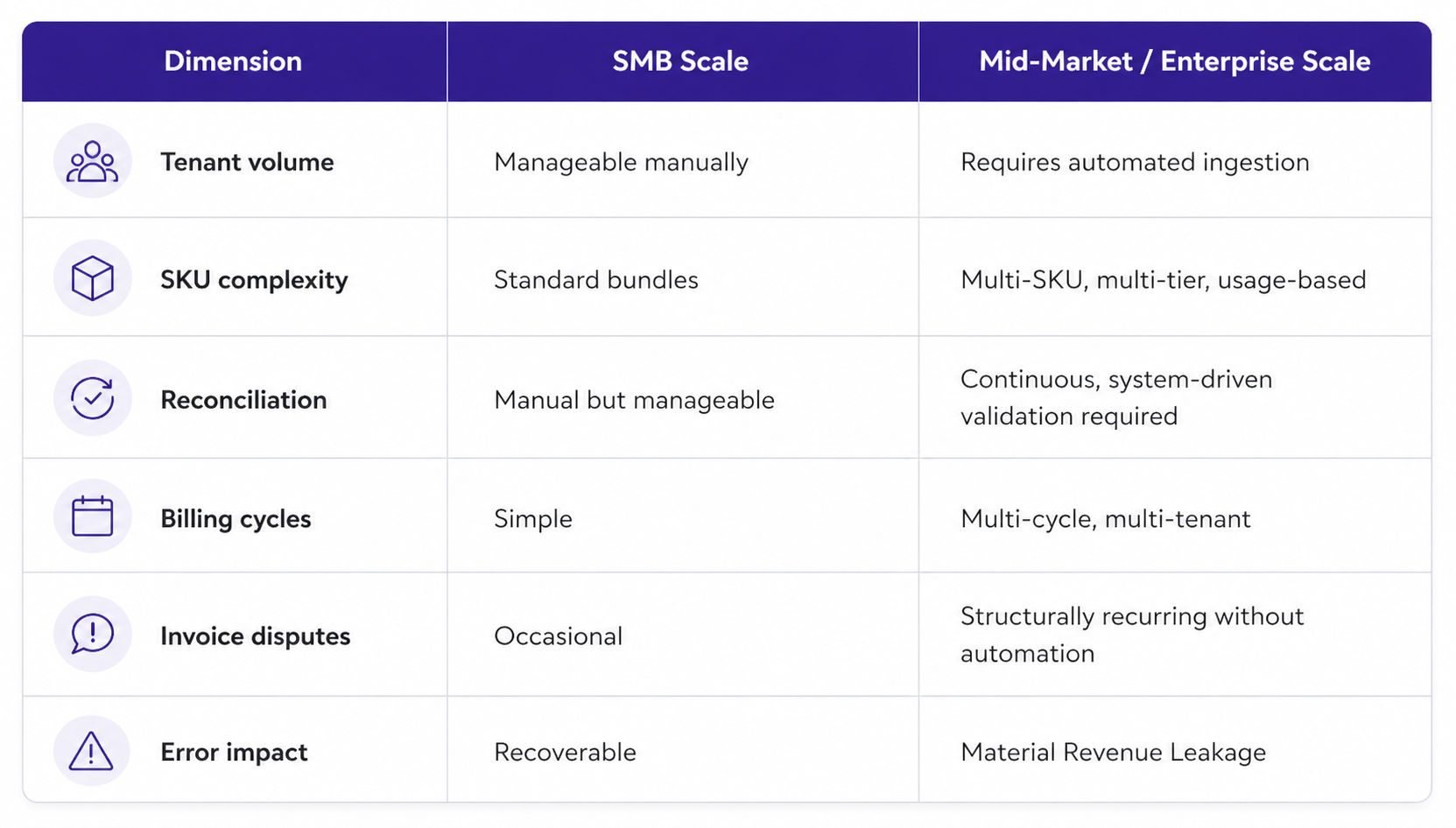
The systems that worked for 50 customers were never built for this level of complexity. CSV exports, manual adjustments, static pricing tables, and monthly spreadsheet reconciliation start breaking down as you scale. By 500, they are not just inefficient, they are structurally unreliable. Errors stop being exceptions to fix and become a built-in cost of operating the business.
Even a small mismatch in usage mapping or pricing logic can create hundreds of incorrect line items across invoices. These errors are often not obvious and can result in underbilling, quietly eroding revenue over time, or overbilling, triggering customer disputes and slowing down payments.
Reconciliation is typically the first point of failure. By the time teams start validating data post-invoice, the volume is already unmanageable, corrections are slow, and billing cycles begin to stretch.
At the same time, systems start to break apart. Microsoft Partner Center holds usage data, CRM systems manage customer and contract records, and finance tools handle invoicing and reporting. Without tight integration across these systems, inconsistencies are inevitable.
Here is how this typically shows up:
- Usage-based billing becomes difficult to track with precision
- Pricing updates create mismatches across systems
- Reconciliation cycles get longer and more error-prone
- Billing cycles stretch, putting pressure on cash flow
- Manual intervention increases across teams
Where CSP Billing Breaks at Scale — Root Causes and Impact
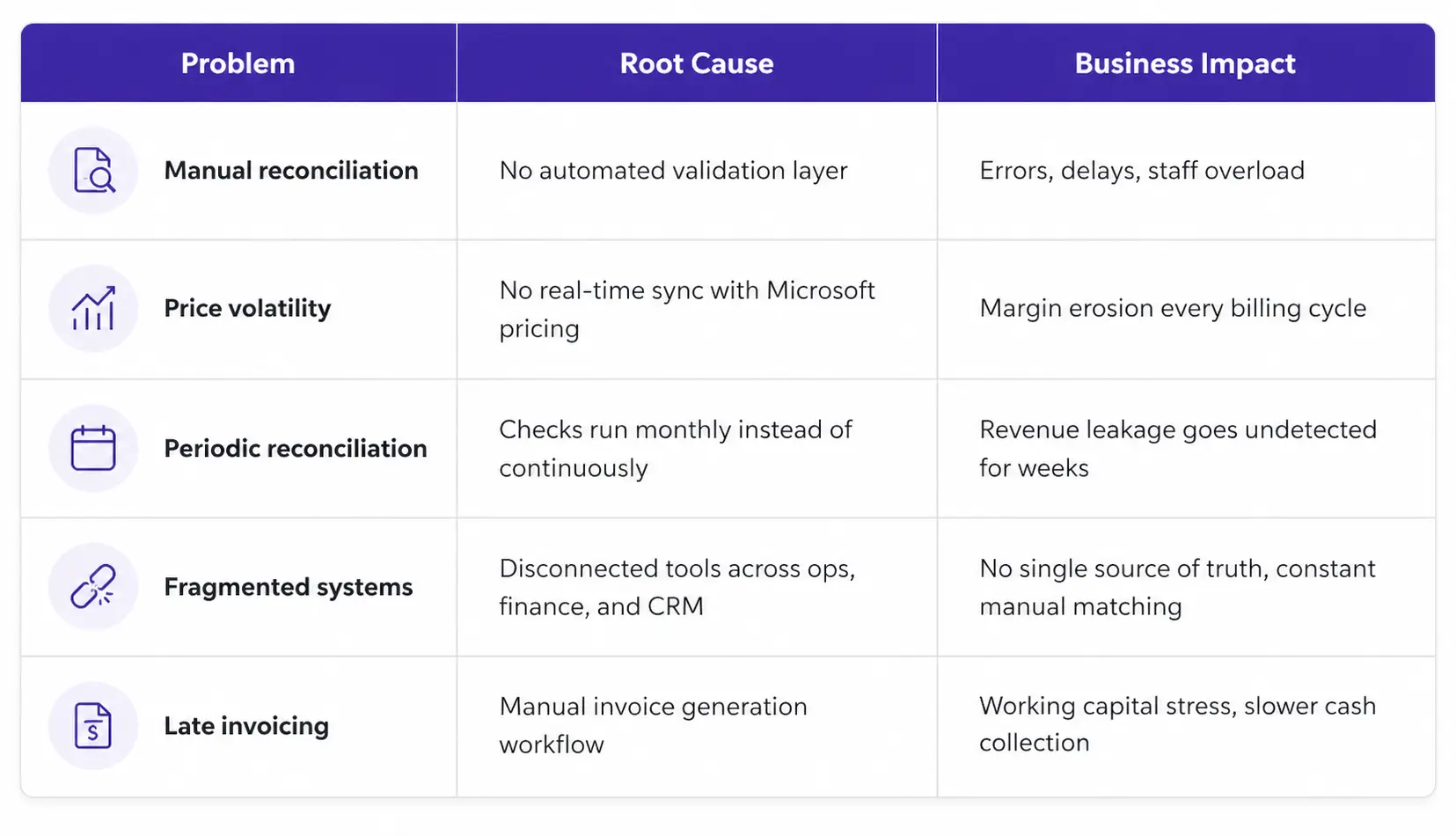
These are not new problems, they are the same issues CSPs learn to manage manually at a smaller scale and then carry forward into an environment where that approach no longer works. The question for every growing CSP in 2026 is not whether these problems exist; it is whether your system is built to prevent them or whether you are still managing them manually
Microsoft CSP Billing Benchmarks 2026
There are no official, standardized benchmarks for Microsoft CSP billing. The sections below reflect consistent patterns seen across high-growth partners at scale, where billing is automated, continuously reconciled, and tightly integrated with revenue systems.
Before getting into metrics, there is a more fundamental shift in how high-growth CSPs approach billing. The numbers only make sense once you understand this shift. At scale, billing is no longer batch-driven; it is event-driven. Every usage event, subscription change, or pricing update triggers an automatic response in the system.
Invoices are simply the output of work that has already been handled upstream. Reconciliation is no longer something done periodically; it runs continuously in the background as a built-in system function, not a monthly task someone has to remember to trigger.
If your billing still depends on periodic runs and manual checks, it is already behind what the system needs to support.
Operational Benchmarks — Speed and Reliability
At scale, operational performance in CSP billing starts to look very different from what most teams are used to.
High-growth CSPs do not wait until the end of the billing cycle to start assembling data. Usage is already flowing in, pricing is applied in real time, and most validation checks are completed well before invoices are generated. As a result, billing cycles that once took days are reduced to a matter of hours.
The approach to errors also changes. In smaller setups, mismatches are expected, and teams build time into the process to identify and fix them. At scale, errors become far less frequent and, when they do occur, they are typically isolated edge cases rather than signs of a broader system issue.
As a result, teams are no longer spending time trying to “close billing” at the end of each cycle. The system handles most of the work continuously, and invoices simply capture what has already been processed.
Financial Benchmarks — Leakage and Cash Flow Control
As your business grows, financial performance starts to reflect how tight your billing system actually is. In less mature setups, revenue leakage is difficult to detect. Small mismatches in usage or pricing often go unnoticed, and over time they compound. High-growth CSPs do not eliminate leakage entirely, but they make it visible and controlled, with issues identified early before they turn into recurring gaps.
Cash flow is where the impact becomes more immediate. Faster billing translates directly into faster collections, because invoices go out on time, are accurate, and require less back-and-forth with customers.
Margins also become more stable. Pricing changes are constant, but a strong system absorbs them cleanly without introducing inconsistencies. The outcome is not just better numbers; it is predictability. You have clear visibility into what is being billed, when it is billed, and how it converts into revenue.
System Benchmarks
In many setups, billing is still stitched together across multiple tools, where usage is pulled from Microsoft Partner Center, adjusted manually, and then passed into finance systems. This approach works at low volumes, but it begins to strain as data grows and complexity increases.
High-growth CSPs simplify this by ensuring that data flows directly from source systems, pricing is applied through clearly defined rules, and everything remains aligned across CRM and finance without constant intervention.
The real shift is consistency, because there are no parallel versions of the same data being edited at different stages of the process. This is what removes most of the friction, as teams are no longer chasing mismatches or fixing broken data pipelines.
Reconciliation Benchmarks
Reconciliation is often treated as a post-billing activity, where invoices are generated first, and validation happens afterward to check if everything lines up. This approach works initially, but as volume grows, it turns into a constant effort to chase mismatches, fix numbers, and make everything reconcile before invoices can be sent.
High-growth CSPs approach this differently. They are not focused on fixing issues at the end of the cycle, but on preventing those issues from moving through the system in the first place. When something breaks, it is not handled as a one-off fix for that cycle; it is traced back and corrected at the source, so it does not recur.
Over time, this fundamentally changes the pattern. The same errors do not keep resurfacing, mismatches are caught early when they are still small and easy to resolve, and most of them never make it to the invoice stage.
Customer Experience Benchmarks
Your billing backend is invisible to customers until something goes wrong. When it works well at scale, the experience on the customer side feels straightforward: invoices match what they expect, arrive when they expect them, and rarely need explanation.
- Little to no invoice disputes across the customer base
- A clear link between usage, pricing, and each invoice line item
- Minimal need to involve support teams to explain charges
- Consistent delivery timelines
When customers start questioning invoices regularly, the issue almost always traces back to how the system is set up. Transparent billing is not something you fix through better communication; it comes from getting the system design right in the first place.
Benchmark Summary
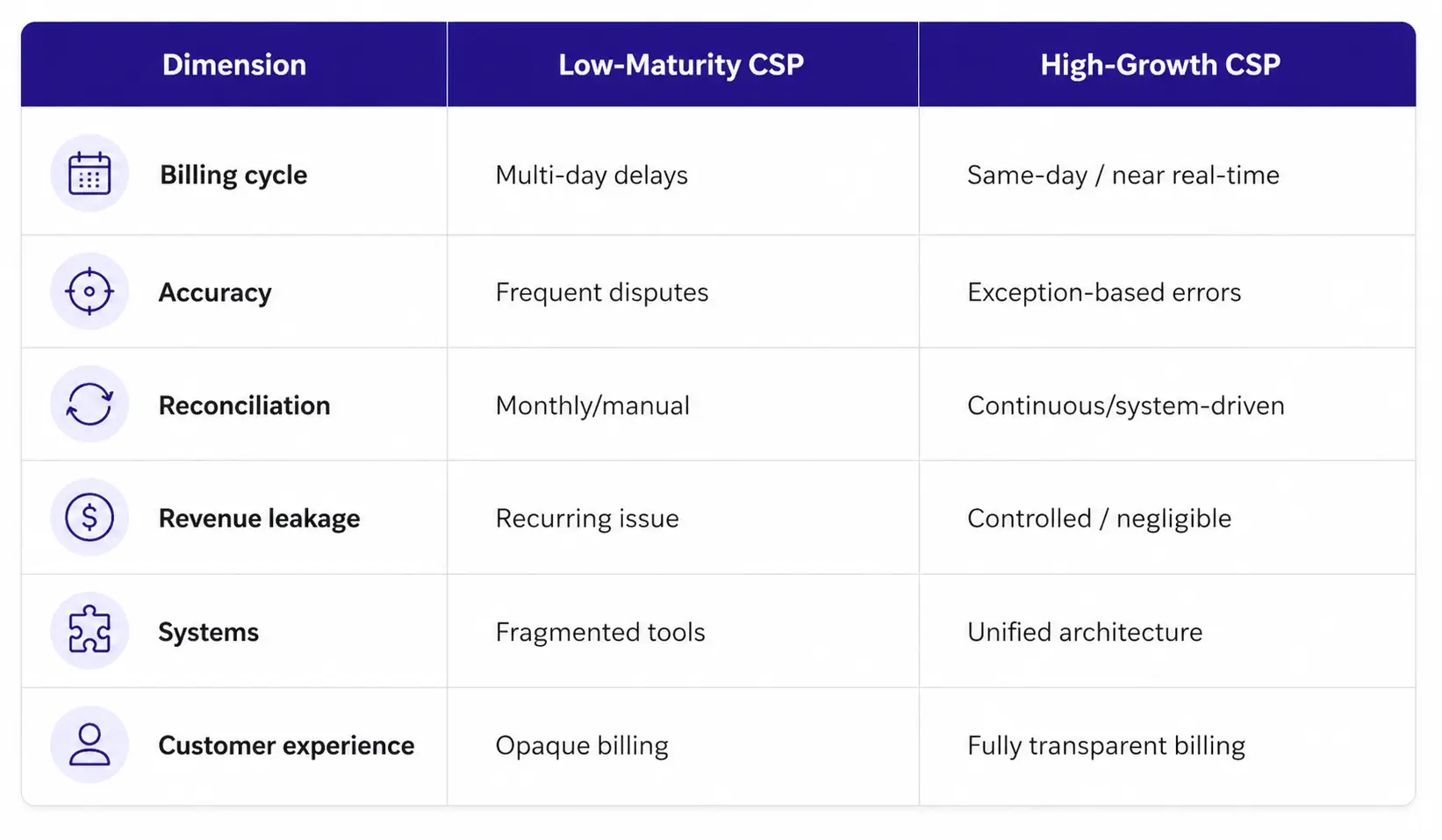
What High-Growth CSP Partners Do Differently
The benchmarks above describe the outcome. This section looks at how the best partners actually reach it, and what sets their day-to-day operations apart from the rest of the market.
They Automate the Full Billing Pipeline, Not Just Invoices
Low-performing CSPs focus on automating the invoice, while high-performing CSPs automate the entire pipeline that generates it. That means API-driven ingestion of usage data from Microsoft Partner Center, not periodic CSV downloads but continuous, real-time feeds flowing into the system. It also means automated tracking of the subscription lifecycle, so every new seat, cancellation, or mid-cycle change is captured and priced correctly without manual intervention. It also involves real-time pricing updates, where the billing engine adjusts automatically when Microsoft introduces a new SKU, changes NCE pricing, or restructures a product bundle.
As a result, when a pricing change drops mid-cycle, high-growth CSPs absorb it automatically and bill customers correctly from day one. Less mature CSPs only realize something is off when margins don’t add up at month-end, by which point the error has already been invoiced and may even have been paid.
They Treat Reconciliation as Part of the System
For most CSPs, reconciliation is a reactive process that happens toward the end of the billing cycle. For high-growth CSPs, reconciliation is built into the system as a continuous function. Every charge is validated against vendor cost and the customer contract the moment it is generated, and anomalies are flagged in real time. By the time invoices are produced, reconciliation is already complete, and every line item has been verified, which removes the need for any month-end scramble.
This is the single biggest operational difference between CSPs that scale efficiently and those that struggle to sustain growth.
They Build a Single Source of Truth
One of the most persistent and costly issues in CSP billing at scale is when Microsoft Partner Center, the CRM, and the finance system each hold different versions of the same customer and subscription data. Teams end up spending hours every week manually cross-referencing records, resolving discrepancies, and trying to determine which system to trust when they conflict.
High-growth CSPs remove this problem by building a unified data layer that feeds all downstream systems from a single source of truth. Customer data, subscription records, usage, and pricing all sit in one place, kept current and consistent at all times. Microsoft itself is moving in this direction through Partner Center consolidation, and the partners that are ahead in 2026 are already operating this way.
They Design Systems That Can Handle Pricing Changes
NCE migration timelines, Microsoft Copilot bundle restructuring, Microsoft Azure consumption-based pricing shifts, and new SKU introductions mid-cycle all point to the same reality: Microsoft’s pricing environment has become more dynamic as the product portfolio expands.
Billing systems that depend on manual updates every time pricing changes are not just inefficient; they are misaligned with how this environment operates. Update delays create margin gaps, manual intervention introduces avoidable errors, and the effect compounds across hundreds of customers and SKUs, turning every pricing change into a potential risk.
High-growth CSPs handle this differently by building pricing logic that is version-controlled and dynamically synced. When Microsoft changes a price, the system absorbs it automatically. When a new bundle is introduced, it fits into the existing pricing structure without rework. Margins stay protected, customers are billed correctly, and commercial teams can sell new products without waiting for billing to catch up.
They Embed Billing into Revenue Operations
Billing at most CSPs still operates as an isolated workflow, where sales closes a deal, operations provisions the subscription, and finance generates the invoice. These steps move sequentially, with handoffs and delays in between, so by the time billing begins, the revenue event is already days or even weeks old.
High-growth CSPs take a different approach by connecting billing directly to the full revenue motion. Sales pipeline activity triggers billing preparation, co-sell tracking feeds into billing records, and incentive calculations run alongside invoice generation. The result is a shorter deal-to-cash cycle and real-time margin visibility at the account level.
They Optimize for Cash Flow, Not Just Accuracy
High-growth CSPs optimize for what accuracy unlocks: faster cash collection, shorter Days Sales Outstanding (DSO), and stronger working capital management.
Faster invoice generation means payment terms start earlier. Automated collections reduce friction in getting paid. Multiple payment options cut down the repeated exchanges that delay settlement. And at 500 customers, the difference between invoicing on day one versus day five of a new period adds up to a meaningful cash flow impact that builds week after week.
Common Pitfalls- What Slows CSPs Down
Most billing problems at scale usually come from decisions made when the business was still small. The patterns are easy to recognize, and they tend to show up in almost every CSP that eventually hits a billing-related growth limit.
Treating Billing as a Finance-Only Function
This means upstream issues like incorrect provisioning, delayed usage data, or untracked subscriptions never get fixed at the source. Billing spans operations, sales, customer success, and finance, and when only one function owns it, the others continue to create problems it has no way to resolve.
Over-Reliance on Spreadsheets
Spreadsheets do not catch errors in real time, do not sync with Microsoft Partner Center, and do not scale. They seem workable early on, but eventually break down, often when a customer disputes an invoice based on data that was entered incorrectly months earlier.
Ignoring Reconciliation
Reconciliation is often overlooked until something breaks, as teams are focused on generating invoices and only checking the numbers when a problem arises. By that point, the issue has already spread across multiple customers or billing cycles.
No Audit Trail
Lack of auditability and explainability quickly becomes a commercial risk in enterprise sales. If you cannot trace every charge on an invoice back to a specific usage event, pricing rule, and contract term within minutes, you are not set up for enterprise accounts.
When something goes wrong, the absence of a clear trail makes it difficult to understand how a number was calculated, which slows down resolution and creates reliance on a few team members who know how the system works.
Late Adoption of Automation
Many partners delay automation and try to stretch manual processes longer than they should. By the time they decide to fix it, billing has already become a bottleneck that slows everything else down. Late adoption of automation is one of the most expensive mistakes, because the cost is not one-time; it builds every billing cycle until the system changes.
Ready to Fix Your CSP Billing at Scale?
CSP billing is no longer a back-office function; it directly shapes how revenue flows through the business. High-growth partners are not just using better tools; they have built systems that perform reliably on a scale. These benchmarks reflect what it takes to operate effectively at mid-market and enterprise scale in 2026.
If your billing still depends on manual reconciliation or fragmented systems, it will eventually slow growth. The Microsoft CSP profitability playbook is a good place to start understanding what operational discipline looks like at scale and how CSP Control Center (C3) can help you get there.
If you want to see how this works in your own setup, you can book a demo and walk through it end-to-end.