 CSP Control Center
 CloudEvents
 CloudLabs
 SaaSify
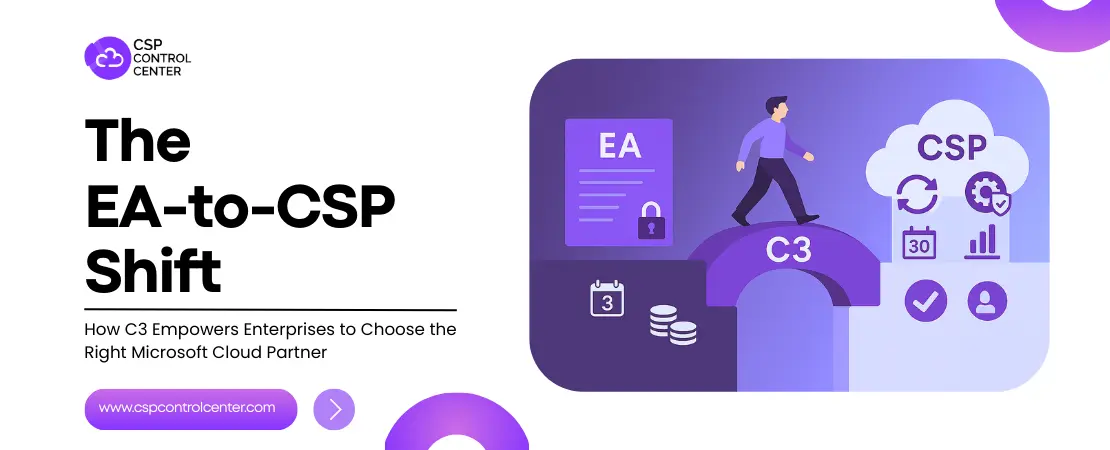

Microsoft Enterprise Agreement (EA) has been the go-to licensing model for large organizations to procure Microsoft licenses for decades. This model offered predictability, packaged pricing, long-term security, and a sense of control over Microsoft products. CIOs and procurement heads could sign the agreement and not worry about it for three years, trusting that the large-scale contract would work in their favour. In 2024 and 2025, enterprises have found themselves navigating rapid digital acceleration, hybrid workforce models, increasing financial scrutiny, and Microsoft’s shift toward the New Commerce Experience (NCE). Microsoft’s NCE has standardized pricing across channels, significantly reducing the volume discounts that once justified EA commitments. At the same time, organizations are under pressure to prove measurable business value from every technology investment, creating real concern among CIOs, CFOs, and procurement teams.
The changing business environment is pushing organizations to question the stability of the traditional EA model. Business leaders are wondering, “Are we getting real value? Why pay for unused licenses? Why does it take six weeks and a dozen emails to adjust our subscription count? Does the Enterprise Agreement still serve us, or is it time to move to Microsoft’s Cloud Solution Provider (CSP) model?”
The CSP program has matured beyond a simple reseller model. It is a modern, flexible alternative that promises monthly billing, no long-term commitments, and integrated partner services. But this opportunity to transition from EA to CSP comes with a critical question: “If we move to CSP, whom do we trust to manage, optimize, and support our Microsoft environment?”
With thousands of CSP partners worldwide, each with different levels of operational maturity, billing hygiene, technical depth, and customer experience, the selection process becomes quite challenging. There is no central quality benchmark, no standardized rating system, and no easy way to select the right Microsoft Cloud Partner. Choosing the wrong partner can lead to financial loss, security vulnerabilities, and operational chaos.
Why Enterprises Are Moving Away from EA
For years, the Enterprise Agreement felt like the obvious choice because it seemed stable, predictable, and suited for big companies. But as cloud adoption accelerates and businesses move faster, many enterprises are now seeing a clear mismatch between what the EA provides and what they actually need in day-to-day operations. Here are the main reasons why enterprises are moving away from EA.
EA Discounts Have Shrunk Under NCE
The original appeal of the EA was simple: ‘commit to a large three-year spend and get substantial volume discounts’. But with Microsoft’s shift to the New Commerce Experience (NCE), pricing across channels has been standardized. Long-standing EA-based discounts are being phased out or reduced; as a result, enterprises are paying nearly the same rates they could get through CSP, without the flexibility CSP provides. So, these discounts no longer justify the rigidity of the model. Furthermore, the EA creates a significant opportunity cost. Capital is trapped in upfront payments for licenses that may go unused.
Long Commitments Are Hard to Manage in a Flexible-Work Era
Three-year license commitments made sense when companies could predict their team size and IT needs for that period. But the last few years have completely changed that reality. The post-pandemic workforce today is unpredictable. Organizations scale up and down frequently, responding to project demands, attrition cycles, seasonal requirements, and global hiring shifts.
Hybrid workforces, contractual teams, and remote employees intensify this issue. The EA forces enterprises to pay for licenses they are not actively utilizing, leading to license sprawl and waste. Adding seats mid-term is possible, but a slow process. Reducing seats is impossible until the anniversary date, forcing enterprises to pay for licences they do not need.
Scaling Up or Down Is Not Simple Under Long Contracts
Modern cloud strategy needs quick action. If a company launches a new product, it must scale its infrastructure immediately. If the market slows down, it needs to cut costs fast. Seasonal businesses have to scale up during busy months and reduce usage when demand drops.
The EA model does not support this kind of agility. If you need more cloud services, you have to raise a request and wait. If you want to adjust your license mix, you must wait until renewal. If you need help with an urgent migration, you are pushed into a centralized and often slow support system.
Lack of Ongoing Value Beyond Licensing
When an enterprise signs an EA, it only gets access to Microsoft licenses and enterprise support. They do not get a partner who is focused on ongoing optimisation or helping them stay efficient over time.
There is no proactive billing support to catch errors before they become invoice disputes. No consumption analytics to identify waste. No security assessments to prevent misconfigurations. The model assumes enterprises have internal expertise to handle everything beyond basic licensing. This gap creates real business risks and leads to missed optimizations that can cost companies millions every year.
Why CSP Is Emerging as the Preferred Enterprise Choice
The Cloud Solution Provider (CSP) program aligns far better with today’s fast-moving, cloud-centric world. It directly addresses the shortcomings of the EA and positions itself as the more modern way for enterprises to consume cloud services.
A More Modern, Customer-Centric Model
CSP program supports agility by offering monthly billing, license adjustments, and service bundling, all of which align naturally with how enterprises operate today. Organizations can increase licenses when they grow and reduce them when things slow down, without facing penalties. CFOs get better control and can plan more accurately instead of committing to three-year assumptions.
Without long-term lock-ins, the CSP partners have to earn the business every month through good service and real value. This kind of accountability does not exist in the traditional EA model, where long contracts and high switching costs keep companies tied in even when the service is not good.
Value Beyond the License: The Integration of Managed Services
CSP is much more than just a licensing program; partners are responsible for the entire lifecycle of the customer. This creates an environment where support and services are part of the relationship itself, not costly extras that need to be purchased separately.
Top CSP partners include full managed services as part of their offering. Their teams send proactive alerts when usage suddenly increases, share rightsizing advice to cut waste, and provide detailed reports that make cloud spending easy to track and control.
Mature CSP partners provide ongoing monitoring, policy enforcement, security checks, and threat response. They set up tenants correctly from the start, monitor for security alerts enterprises often miss, and implement governance frameworks.
Strategic cloud consulting, roadmap planning, solution design, and technology reviews help enterprises make smarter decisions instead of buying tools or services based on sales pitches.
Direct Access to Knowledgeable Partner Support
When IT teams face issues under an EA, they usually have to raise tickets through Microsoft’s central support system. Response times can be slow, and the support teams often have very little understanding of specific business needs.
In CSP partnerships, enterprises get direct access to a single partner who understands their setup, business needs, and long-term goals. This usually results in faster and more personalised support because the partner has a clear incentive to keep service quality high.
CSP partners can also provide assistance in local languages, understand regional compliance requirements, and navigate country-specific regulatory frameworks.
Transparent, Predictable Pricing
Monthly invoicing gives clear visibility into every license and service. CFOs can plan better because the costs match actual usage, not old commitments. According to the Flexera 2025 State of the Cloud Report, “84% of the cloud decision-makers and users find it difficult to manage cloud spend.” Budgeting becomes a data-driven process instead of guesswork. This level of transparency helps leaders make smarter decisions. When finance teams clearly see what is driving cloud costs, they can make informed choices. It also becomes easier to spot unusual spikes early and fix them before they turn into major budget overruns.
The Enterprise Challenge: “How Do We Choose the Right CSP Partner?”
Shifting from EA to CSP solves many of the rigidity and visibility issues enterprises face, but it introduces a new and equally critical decision: choosing the right partner. The CSP partner is not just a provider but someone who has to take care of financial governance, operational integrity, and security posture. Marketing claims and sales pitches cannot reveal how well a partner actually manages licensing, governance, or customer experience.
The Overwhelming CSP Landscape
There are thousands of CSP partners worldwide. These providers have different specializations, maturity levels, and operational capabilities. Some partners use highly advanced platforms offering automated billing, proactive system monitoring, and full-scale managed services. Some are barely able to manage basic license provisioning and provide minimal ongoing support.
There is no central Microsoft “rating” system to separate the exceptional from the mediocre. Every partner claims to be customer-focused; their websites highlight certifications, case studies, and promise great support. But none of this shows how they actually run their internal operations.
Risks of Choosing the Wrong Partner
The consequences of choosing the wrong CSP partner are much more than minor inconveniences.
Billing Errors
If the partner has weak billing practices, they send inaccurate or delayed invoices, apply incorrect pricing, or fail to reconcile usage properly. This leads to invoice disputes and loss of budget control.
Misconfigured Licenses
Subscription mismatches and failed renewals leading to service interruptions. Poor license management leads to overspending on unused licenses and not having enough when teams actually need them. It wastes budget and slows down productivity at the same time.
Security and Compliance Gaps
Partners who misconfigure Azure tenants, ignore security alerts, or implement inadequate governance policies expose enterprises to breaches and regulatory violations.
Governance Failure
Without proper consumption dashboards and usage reports, Azure spend can spiral out of control, and enterprises will have no visibility into how their licenses are being utilized.
Delayed Support
When partners lack the technical depth or operational processes to resolve problems quickly, minor issues lead to business downtime that costs far more than any licensing savings.
Hidden Fees or Poor Transparency
Partners who are not transparent about markups, service fees, or support charges create unexpected costs. These surprises can hurt the IT team’s credibility with finance leaders.
The Need for a Data-Driven Selection Approach
Traditional evaluation methods do not provide the clarity enterprises need. References often highlight only the best success stories. Marketing claims cannot be verified. Presentations show what the partner can do, not how well they actually deliver day to day. Even technical certifications cannot tell whether a partner follows proper renewal workflows, applies governance checks, or uses automation to avoid manual mistakes. Yet these are the things that actually determine how smoothly your CSP experience will run once the partnership begins.
Enterprises need a neutral, data-driven way to measure partner maturity. They need visibility into real operational metrics like billing accuracy, renewal success rates, support response times, and security compliance. Without this kind of insight, choosing a partner becomes difficult.
Introducing C3: The Operational Backbone of High-Quality CSP Partners
As enterprises think about moving from EA to CSP, the next question is how to find truly capable partners. This is where CSP Control Center (C3) becomes essential. C3 isn’t a reseller, a consulting firm, or another CSP vendor trying to stand out. It is the operational backbone used by many of the most mature and dependable CSP partners globally. C3 provides automated billing, financial governance, subscription lifecycle management, automated renewals, real-time Microsoft catalog sync, pricing accuracy checks, customer self-service portals, usage dashboards, and much more.
Because C3 operates at the core of a partner’s business, it has real-time insight into their maturity and quality. A partner using C3 is not just choosing a tool. They are committing to a higher standard of operational excellence.
How C3 Helps Enterprises Identify the Right CSP Partner
By understanding what C3 enables, enterprises can ask the right questions and quickly identify partners who run their operations with automation, accuracy, and discipline. Knowing how C3 works helps organizations separate partners who have the right infrastructure to deliver on their promises from those still dependent on manual processes that eventually lead to mistakes, delays, and inefficiencies.
Billing Accuracy and Transparency as a Non-Negotiable
Billing is usually the first area where enterprises notice the difference between a mature and an immature CSP partner. Inaccurate invoices, incorrect pricing, delayed reconciliations, or missing usage details can cause friction between IT, procurement, and finance teams. Over time, these issues damage confidence in the entire CSP model.
C3 automates the entire billing process. It syncs directly with Microsoft’s systems, applies the correct rates, and generates accurate, transparent invoices every single month. For an enterprise, this means no more billing disputes, no surprise charges, and complete confidence in their monthly cloud spend. When evaluating a partner, ask about their billing automation. CSP partners who use C3 demonstrate stronger billing practices.
Operational Maturity: The Real Differentiator
Beyond billing, operational maturity is what separates partners who can scale smoothly from those who start to struggle as customer needs grow. By automating the core operations, C3 makes the customer experience smooth and reliable.
- Automated Renewals: It manages the entire renewal process, sending proactive notifications and preventing costly service lapses that can occur when renewals are handled manually.
- Subscription Lifecycle Controls: Adding, removing, or changing licenses is a streamlined, automated process.
- Real-Time Catalog Sync: The partner always has access to the latest Microsoft SKUs and pricing, ensuring every quote and every invoice is 100% accurate.
- Partner and Customer Portals: C3 provides the white-labeled portals that partners use to offer their customers real-time visibility into their subscriptions, costs, and support tickets.
Enterprises moving from EA should look for partners with strong automation, because manual processes eventually fail when the environment becomes complex. A partner who can clearly show these automated workflows can scale reliably, maintain accuracy, and support the enterprise without disruption.
Service Quality and Response Time
C3-powered partners resolve issues faster because the built-in workflows remove manual delays and keep everything moving efficiently. C3 provides built-in, structured workflows for support ticket management, SLA tracking, and communication. The result is a much smoother cloud experience for enterprise teams. Issues are resolved faster, and the enterprise has a clear audit trail of all support interactions.
Compliance and Governance Standards
For regulated industries like finance and healthcare, this is very critical. C3 provides clear, auditable processes that help partners stay aligned with Microsoft policies and meet enterprise compliance requirements. Every action, from license provisioning, subscription modification and support interaction, creates audit trails that compliance teams can review.
This governance layer lowers compliance risk for enterprises. When partners operate on C3 infrastructure, organizations can trust that licensing is handled correctly, security policies are applied consistently, and operational processes meet the required regulatory standards.
Cost Visibility and Consumption Transparency
Cost visibility is important for enterprises moving from EA. C3 enables CSP partners to offer detailed dashboards, automated notifications, and usage analytics. These insights help enterprises understand how their licenses are being utilized, where costs are spiking, and which areas require optimization.
This transparency transforms how enterprises manage cloud costs. Finance leaders can forecast accurately, and IT teams can identify optimization opportunities.
The C3 Advantage: Making EA-to-CSP Migration Seamless
The CSP program offers flexibility, transparency, and better operational alignment. But moving from EA to CSP is more than just switching licensing models. It requires a change in how subscriptions are managed, how billing is checked, and how the cloud environment is handled every day. C3 addresses this challenge by providing the automation, accuracy, and operational consistency that enterprises need throughout the transition.
Recommending High-Quality CSP Partners
C3 helps identify high-quality CSP partners who have already demonstrated real operational maturity through the platform. C3 observes how partners manage billing accuracy, lifecycle controls, renewal processes, and catalog synchronization, which offers a realistic picture of their dependability.
C3 can suggest enterprises with partners based on geography, industry needs, cloud maturity, and the level of service they expect. This leads to recommendations that align with both operational performance and practical needs.
Ensuring a Smooth, Controlled Transition
When shifting from EA to CSP, subscriptions need to be mapped correctly, renewal timelines must be aligned, pricing must be verified, and provisioning should happen without disrupting users. C3 reduces these risks by giving CSP partners a clear, automated system to handle the entire transition smoothly.
The high level of automation ensures that the move from EA to CSP happens without duplicated licenses, billing gaps, or configuration errors that could disrupt business operations.
Driving Ongoing Value Post-Migration
What sets a strong CSP partnership apart is not just how well the migration is done, but how consistently the partner delivers value after the move. C3 supports this long-term value through ongoing automation and governance. Partners using C3 can give enterprises clear insights into consumption, proactive alerts, optimisation suggestions, and visibility into license usage. They can also flag security issues, configuration gaps, and unusual cost spikes before they become bigger problems.
EA to CSP as a Strategic Business Opportunity
The move from EA to CSP is not a downgrade or a simple replacement of one licensing framework with another. It is a chance for organisations to rethink how they manage cloud usage, enforce governance, plan budgets, and use technology to support business growth. With the right CSP partner and C3’s operational intelligence in place, cloud governance becomes proactive rather than reactive. Instead of discovering problems later on, enterprises receive continuous visibility and optimization recommendations. IT teams get the agility to match the pace of business, and finance teams are able to predict and control costs.
Considering a Move From EA to CSP?
If you are exploring CSP as an alternative to the traditional EA model, C3 can help you make the transition with confidence. Since C3 powers many of the most mature CSP providers across the globe, it can guide you toward partners who deliver accuracy, strong governance, and consistent support.
Whether you want better pricing, improved visibility, or a more reliable cloud experience, C3 can help you identify the right partner for your region, industry, and cloud maturity.
Ask us for a curated list of top CSP partners who align with your needs.